

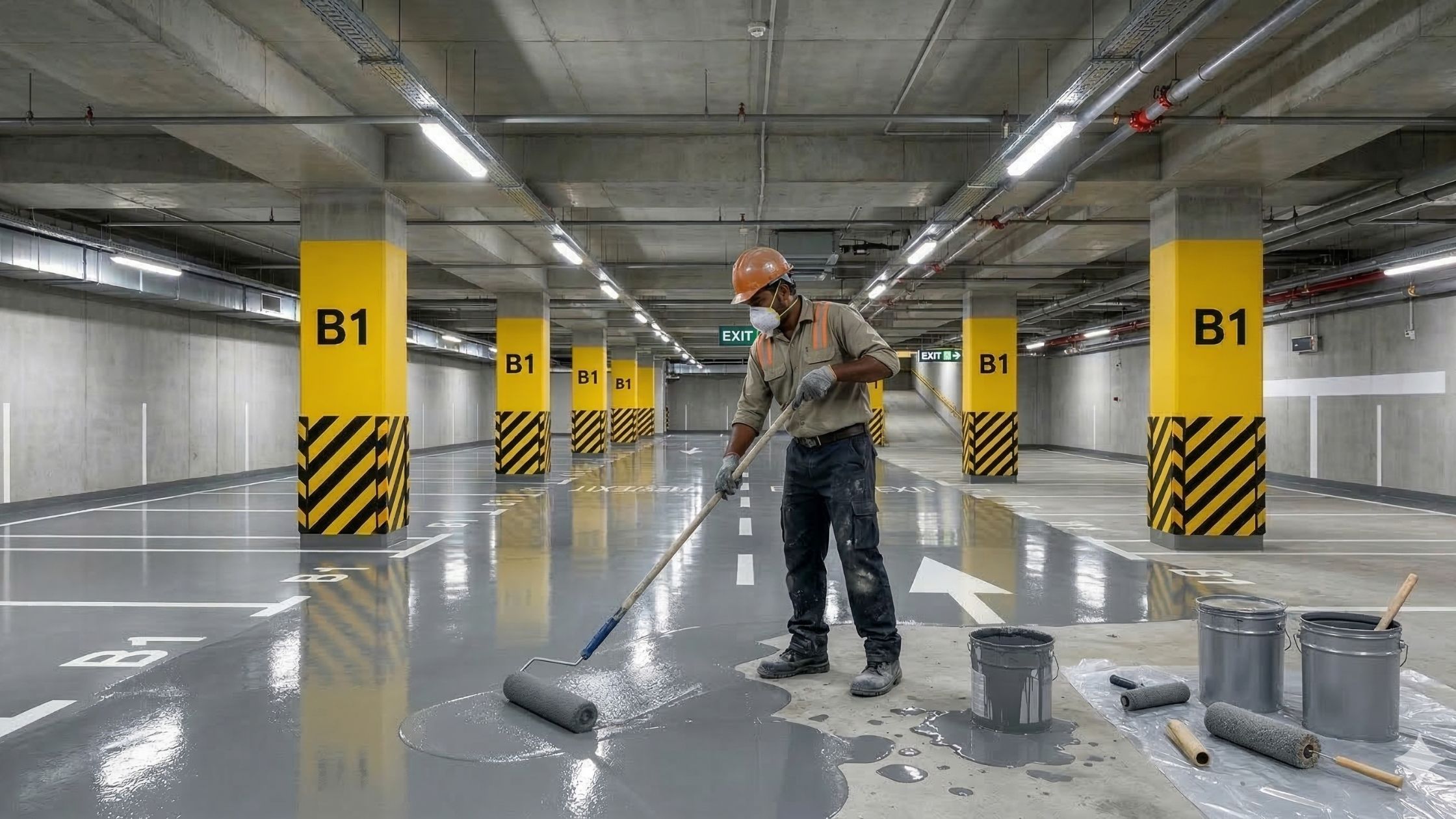
Are your residential complex’s parking areas showing signs of wear, staining, and deterioration? Effective parking structure protection needs more than just a coat of paint. It demands a systems-based approach tailored to the specific needs of residential living.
In this guide, we will analyze critical performance requirements and outline the criteria necessary to ensure long-term durability, resident safety, and a strong return on investment.
Contents
- 1 What are the Unique Challenges of Residential Car Park Flooring?
- 2 What are the Essential Performance Requirements for Residential Car Park Floorings?
- 3 What are the Flooring Options for Residential Car Parks?
- 4 A Maintenance Guide for Housing Societies
- 5 Sunanda Global’s Advanced Car Park Flooring Solutions
- 6 SUNEPOXY FLR HB: High-Build Epoxy Floor Coating
- 7 Why Sunanda Global Is Your Trusted Partner for Residential Car Park Flooring
- 8 FAQs
- 9 1. Can car park flooring be applied over existing tiles or coatings?
- 10 2. Does car park flooring require special maintenance or cleaning products?
- 11 3. Can car park flooring address existing cracks and surface damage?
- 12 4. How to tackle wet car parks during monsoons?

What are the Unique Challenges of Residential Car Park Flooring?
Residential parking areas operate under distinct conditions that differentiate them from commercial or industrial facilities
- Mixed Usage Patterns: Unlike office spaces with predictable traffic patterns, residential car parks experience round-the-clock usage. Vehicles arrive and depart at all hours, creating continuous wear without relief periods for maintenance or repairs
- Diverse Vehicle Types: From compact sedans to heavy SUVs, the vehicle mix in residential complexes varies significantly. This range creates uneven load distribution and wear patterns that flooring must accommodate without premature deterioration.
- Aesthetic Expectations: Residents view parking areas as extensions of their homes. Stained, cracked, or deteriorating floors create negative impressions and can affect property values.
- Moisture and Drainage Issues: Residential basements often face groundwater seepage and inadequate drainage. Without a proper waterproofing chemical for concrete, moisture rises through floor slabs, causing coating delamination and substrate deterioration.
- Limited Maintenance Windows: Coordinating repairs in occupied residential buildings is challenging. Residents resist prolonged parking restrictions, making quick-curing, low-disruption solutions essential for the renovation project.
What are the Essential Performance Requirements for Residential Car Park Floorings?
- Durability Under Traffic: Must withstand constant vehicle movement, tire function, and turning forces without premature wear
- Chemical Resistance: Must resist oil, coolant, brake fluid, and cleaning chemicals without staining or softening
- Slip Resistance: Must provide adequate traction for vehicles and pedestrians, especially when wet during monsoons
- Crack Bridging & Flexibility: Must accommodate substrate movement from thermal cycling or settling without cracking
- Moisture Vapour Tolerance: Must resist moisture transmission from below-grade concrete to prevent delamination
- Aesthetic Longevity: Must maintain colour stability, gloss, and stain resistance to avoid becoming an eyesore
What are the Flooring Options for Residential Car Parks?
Multiple flooring technologies compete in the residential parking market, each with distinct advantages and limitations.
Epoxy Coatings
These provide excellent chemical resistance, hardness, and adhesion. However, epoxy floorings can be slippery when wet and may yellow under UV exposure near entrance areas. Premium epoxy for industrial flooring formulations addresses some limitations but requires proper specification.
Polyurethane Systems
These offer superior flexibility, UV resistance, and aesthetics compared to epoxy. They maintain their appearance better over time, resist chemicals, and yellowing. The trade-off is that it costs more than epoxy.
Hybrid Epoxy-Polyurethane
Combining epoxy’s durability with polyurethane’s aesthetics creates optimal systems. Epoxy base coats provide chemical resistance and substrate adhesion, while polyurethane topcoats deliver appearance and flexibility.
Polished Concrete
Mechanical densification creates durable, low-maintenance surfaces without coatings. However, it lacks chemical resistance and can still stain from oil and fluids common in parking areas.
A Maintenance Guide for Housing Societies
Proactive maintenance is crucial for preventing costly replacements and extending flooring service life.
- Regular Cleaning: Use pH-neutral detergents. Harsh chemicals or abrasives damage coatings. Sweeping and periodic help maintain the appearance.
- Immediate Spill Response: Train staff to clean oil and fluid spills promptly to prevent permanent stains.
- Periodic inspections: Conduct quarterly visual checks to identify early wear or damage, allowing targeted repairs before issues escalate.
- Drainage Maintenance: Keep drains and outlets clear. Standing water accelerates degradation and creates slip hazards.
- Preventive Recoating: Plan for topcoat renewal every 5-7 years, which is far more cost-effective than full replacement.
- Documentation: Maintain records of installation, products used, and maintenance history for warranty claims and future renovations.
Sunanda Global’s Advanced Car Park Flooring Solutions
Sunanda Global offers specialized flooring systems engineered for residential parking applications that address the unique challenges faced by housing societies and residential developers.
SUNEPOXY PU: Epoxy Polyurethane Self-Levelling Flooring
It’s a premium hybrid coating combining epoxy durability with polyurethane flexibility. Ideal for areas requiring hygiene, abrasion resistance, and chemical protection.
Key Features:
- Self-leveling, non-shrink formulation
- Excellent chemical and abrasion resistance
- Superior adhesion to concrete
SUNEPOXY FLR HB: High-Build Epoxy Floor Coating
A high-performance, solvent-free epoxy coating for maximum durability in high-traffic areas.
Key Features:
- Excellent abrasion resistance
- Hygienic finish suitable for residential environments
- Available in a wide range of shades
- Superior adhesion to concrete
Why Sunanda Global Is Your Trusted Partner for Residential Car Park Flooring
With over 45 years of experience in Indian industrial construction, Sunanda Global leads in innovation in construction chemical coatings. We invest 5% of annual revenue in R&D, focusing 60% of our efforts on LEED-compliant and eco-friendly products. We also hold ISO 9001:2015 certification.
As the best waterproofing company in India, our low-VOC, environmentally conscious water leakage solutions deliver top performance. Moreover, Sunanda Global provides full support: from technical advice to vetted partners. With us, you can expect reliable on-site execution through trusted waterproofing contractors in Bangalore, Chennai, Hyderabad, Mumbai, and other major cities.
Contact Sunanda Global for car park flooring solutions that combine scientific innovation, proven durability, and reliable performance backed by decades of expertise.
FAQs
1. Can car park flooring be applied over existing tiles or coatings?
Generally, existing coatings should be removed for optimal adhesion. However, well-bonded systems may be overcoated after proper preparation, testing, and compatibility assessment by technical experts.
2. Does car park flooring require special maintenance or cleaning products?
Regular sweeping and mopping with pH-neutral detergents suffices. Avoid harsh chemicals, acidic cleaners, or abrasive scrubbing that damages coatings. Prompt cleanup of oil spills maintains appearance.
3. Can car park flooring address existing cracks and surface damage?
Yes, proper surface preparation includes crack filling, repair of spalled areas, and substrate leveling. Combined with flexible coating systems, this prevents crack reflection and ensures smooth surfaces.
4. How to tackle wet car parks during monsoons?
Quality flooring systems incorporate slip resistance through textured finishes or broadcast aggregates. Properly specified floors maintain safe traction even when wet, meeting safety requirements for residential applications.