

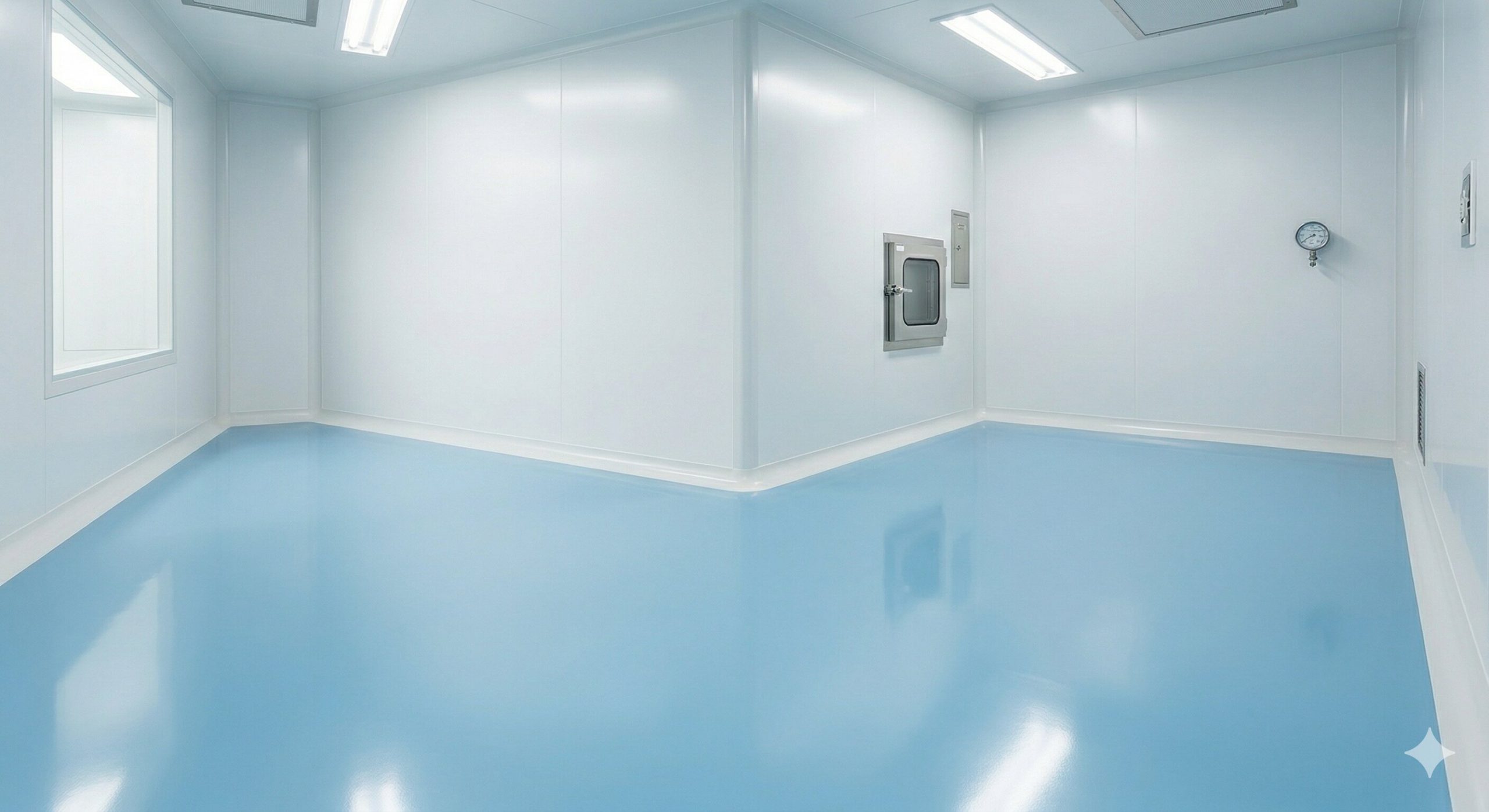
A single contamination incident in pharmaceutical manufacturing can lead to product recalls, regulatory penalties, and reputational damage. Pharmaceutical cleanrooms operate under strict regulatory oversight where every material, surface, and process faces rigorous scrutiny, making Cleanroom Flooring essential for maintaining controlled, compliant, and contamination-resistant environments.
Traditional flooring systems designed for industrial or commercial applications may fail to meet the standards of pharmaceutical manufacturing. Non-compliant flooring creates particle generation, harbours microbial growth, and degrades under aggressive sanitization protocols, compromising the entire contamination control strategy.
Contents
- 1 What are the Pharmaceutical Cleanroom Classifications and Requirements?
- 2 What are the Regulatory Compliance Standards for Pharmaceutical Flooring?
- 3 Choosing the Right Materials for Cleanroom Flooring
- 4 What are the Installation Methods That Prevent Contamination?
- 5 Sunanda Global’s Pharmaceutical Cleanroom Flooring
- 6 Why Choose Sunanda Global for Pharmaceutical Cleanroom Flooring
- 7 FAQs

What are the Pharmaceutical Cleanroom Classifications and Requirements?
Pharmaceutical facilities must maintain extremely clean environments to ensure product safety and quality. Different areas require different levels of cleanliness depending on what’s being manufactured.
Cleanroom Cleanliness Levels:
Pharmaceutical cleanrooms are classified by how clean the air needs to be, measured by particle counts. These classifications represent different grades of environmental cleanliness required for pharmaceutical production:
- ISO Class 5 (Highest cleanliness): Typically used for critical aseptic operations such as sterile filling and sealing
- ISO Class 6-7 (Moderate cleanliness): Used for controlled manufacturing, preparation, and background environments supporting critical operations
- ISO Class 8 (Basic cleanliness): Packaging, storage, and general manufacturing areas
The cleaner the room needs to be, the more demanding the flooring requirements become. Floors in the cleanest areas must be absolutely smooth and seamless, while general manufacturing areas have slightly more flexibility.
Why This Matters for Flooring
Regulatory bodies such as the WHO (World Health Organization), India’s Schedule M, and international agencies require that floors in these areas not contribute to contamination. This means flooring must be:
- Smooth and seamless
- Easy to clean thoroughly
- Resistant to repeated exposure to harsh cleaning chemicals
- Unable to shed particles or harbour bacteria
What are the Regulatory Compliance Standards for Pharmaceutical Flooring?
Pharmaceutical flooring must meet quality and safety standards set by various regulatory bodies. Here’s what they require:
Indian Schedule M (Good Manufacturing Practices)
India’s pharmaceutical manufacturing guidelines require:
- Smooth, water-resistant surfaces in production areas
- Materials that handle repeated cleaning without breaking down
- Seamless floors that are easy to clean with minimal joints to prevent contamination buildup
- Materials must not affect product quality or introduce contamination
WHO and International Standards
Global health organizations require pharmaceutical floors to be:
- Smooth and crack-free
- Made from materials that don’t shed particles
- Able to withstand harsh cleaning chemicals
- Curved where walls meet floors (preventing dirt buildup in corners)
These standards ensure floors don’t contaminate medicines or compromise product safety
Choosing the Right Materials for Cleanroom Flooring
Pharmaceutical floors need special materials that can handle the unique demands of medicine manufacturing.
Chemical Resistance
Pharmaceutical facilities use strong cleaning chemicals, including hydrogen peroxide for deep disinfection, specialised disinfectants for microbial control, and heavy-duty cleaners for contamination events.
Flooring must resist all these chemicals without fading, cracking, or breaking down, even after years of daily use.
Safe, Non-Toxic Material
Pharmaceutical floors cannot:
- Release fumes or odours that could contaminate medicines
- Contain toxic substances or heavy metals
- Create particles that could get into products
Only specially formulated, pharmaceutical-grade materials meet these safety requirements
Durability Under Daily Use
Despite their pristine appearance, cleanroom floors face constant stress:
- Equipment and cart traffic throughout the day
- Weight from manufacturing machinery
- Temperature changes from the air conditioning
- Wear from frequent cleaning
Material must stay intact without creating dust or particles from wear
The Right Surface Finish
Pharmaceutical floors need to be:
- Smooth enough to prevent bacteria from sticking
- Slightly textured for safety (non-slip)
- Consistent across the entire area
What are the Installation Methods That Prevent Contamination?
Proper installation is critical for maintaining cleanroom hygiene and regulatory compliance.
1. Seamless Surfaces
Traditional tiles and sheet flooring create joints where contaminants can accumulate. So, pharmaceutical cleanrooms use seamless systems such as self-leveling liquid flooring that form a continuous surface. Curved wall–floor transitions further prevent dirt buildup.
2. Surface Preparation
Successful installation begins with proper substrate preparation. The concrete must be dry, clean, and mechanically profiled for strong adhesion. Any cracks, contaminants, or weak areas should be repaired before coating application.
3. Quality Control During Installation
Installation must be carried out under controlled conditions. Temperature and humidity should be maintained within recommended limits, contamination must be prevented during application, and each layer should be inspected and documented for regulatory compliance.
Sunanda Global’s Pharmaceutical Cleanroom Flooring
Sunanda Global offers flooring systems for pharmaceutical cleanroom applications that meet stringent regulatory requirements and sanitization demands
SUNEPOXY SL
A self-leveling epoxy flooring solution designed for pharmaceutical cleanrooms requiring seamless, smooth surfaces. This solvent-free, two-component system creates monolithic floors. Its excellent chemical resistance prevents degradation, discolouration, or loss of physical properties.
SUNCRETE PU MF
An advanced polyurethane-modified cement flooring system combining pharmaceutical compliance with enhanced mechanical durability. SUNCRETE PU MF excels in high-traffic pharmaceutical zones experiencing heavy equipment and has superior abrasion resistance. It also provides exceptional chemical resistance
Why Choose Sunanda Global for Pharmaceutical Cleanroom Flooring
With over 45 years of experience in Indian industrial construction, Sunanda Global leads in innovation in construction chemical coatings. We invest 5% of annual revenue in R&D, focusing 60% of our efforts on LEED-compliant and eco-friendly products. We also hold ISO 9001:2015 certification.
As the best waterproofing company in India, our low-VOC, environmentally conscious water leakage solutions deliver top performance. Moreover, Sunanda Global provides full support: from technical advice to vetted partners. With us, you can expect reliable on-site execution through trusted waterproofing contractors in Bangalore, Chennai, Hyderabad, Mumbai, and other major cities.
Contact Sunanda Global for cleanroom flooring solutions that combine scientific innovation, proven durability, and reliable performance backed by decades of expertise.
FAQs
Q1. What cleanroom classifications require specialized flooring systems?
All pharmaceutical cleanrooms require compliant flooring. Higher classifications demand maximum smoothness and chemical resistance, while lower classes allow more economical systems meeting basic GMP requirements.
Q2. How often should pharmaceutical cleanroom floors be replaced?
Replacement timing depends on use intensity, sanitization frequency, mechanical wear, and regulatory inspection findings rather than predetermined schedules.
Q3. What sanitizers are most aggressive to cleanroom flooring?
Oxidising agents (hydrogen peroxide, peracetic acid) and phenolic compounds prove most aggressive. Flooring must withstand these, alongside alcohol, quaternary ammonium compounds, and chlorine-based sanitizers used in rotation protocols.
Q4. How does flooring impact cleanroom particle counts?
Non-compliant floors generate particles through degradation, shedding, or improper cleaning. Compliant systems eliminate this contamination source, contributing significantly to maintaining specified particle count limits and preventing contamination events.