

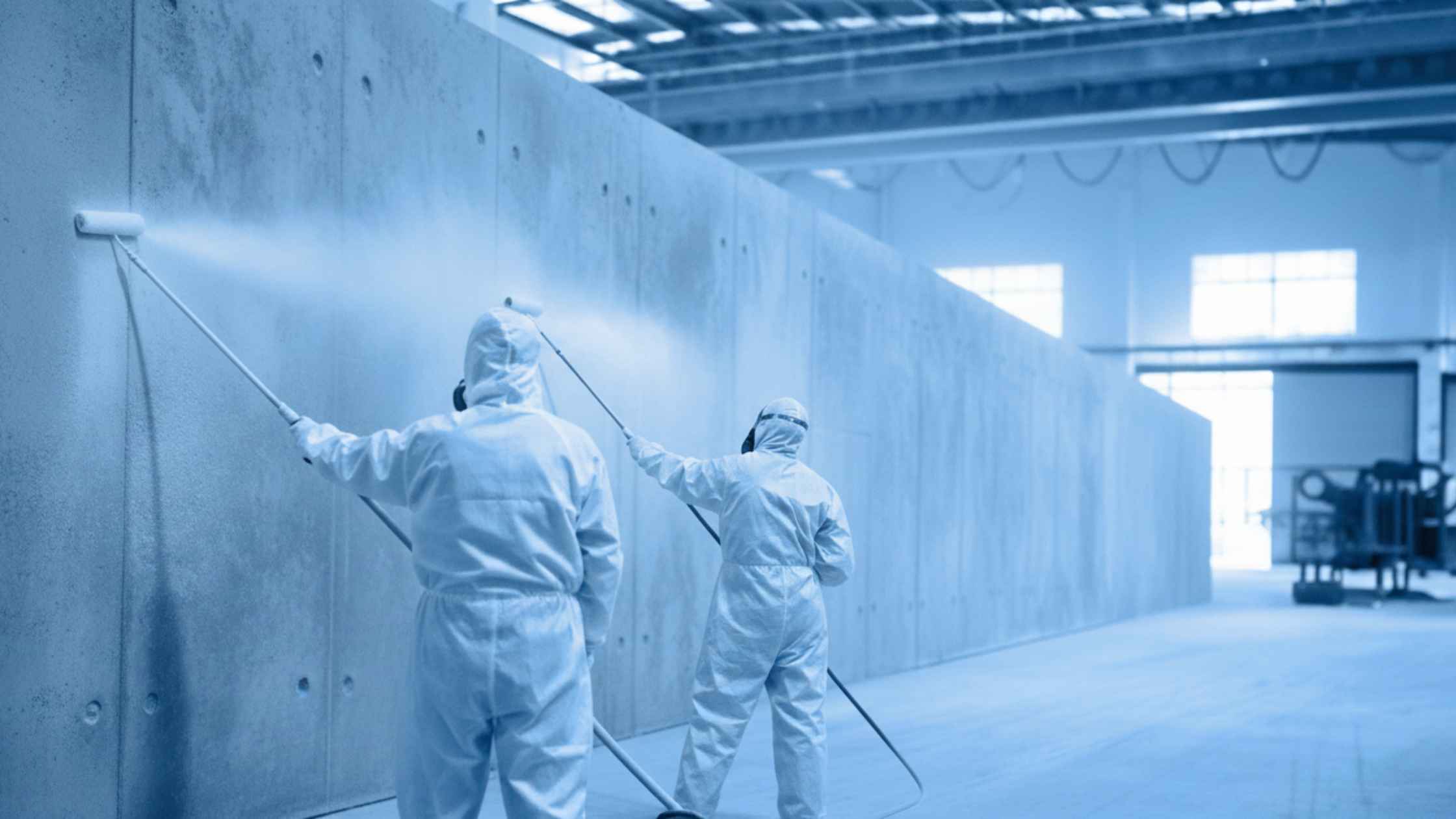
Are you investing in the wrong protective coating for your industrial facility? The choice between epoxy and polyurethane systems significantly impacts performance, longevity, and maintenance costs, yet many facility managers select coatings based on incomplete information.
Choosing incorrectly can result in premature coating failure, unexpected downtime, and costly reapplication projects. In this comprehensive guide, we’ll examine the fundamental differences between these two industrial protective coatings, identify when each system performs best, and explore industry-specific requirements.
Contents

What are Epoxy and Polyurethane Industrial Protective Coatings?
While epoxy and polyurethane are both high-performing industrial protective coatings, they possess different molecular structures that dictate their mechanical properties. Understanding these differences assists in proper material specification.
Epoxy Coatings
Epoxy systems consist of resin and hardener components that undergo a chemical curing process called cross-linking.
- It cures into a rock-hard film that has superior adhesion to substrates
- Epoxy has excellent chemical resistance against acids, solvents, and aggressive corrosives, which makes it the preferred choice for industrial applications
- Epoxy also has notable limitations, like poor UV resistance. Epoxy will chalk, fade, and lose gloss rapidly under continuous UV exposure. While it doesn’t immediately compromise the protection, it affects the aesthetics.
Polyurethane Coatings
Polyurethane systems also use two-component chemistry, but their molecular structure differs from that of epoxy systems.
- UV stability is the key advantage. These coatings maintain colour, gloss, and appearance even under prolonged sun exposure, making them ideal for exterior applications.
- It also offers excellent abrasion resistance and impact tolerance. The coating’s flexibility allows it to absorb impacts without cracking.
- Chemical resistance is good, but generally inferior to epoxy, which makes polyurethane better suited for moderate chemical exposure rather than harsh industrial environments or as a topcoat over epoxy..
When to Choose Epoxy Coatings
High Chemical Exposure Environments
Choose epoxy when facilities handle aggressive chemicals like acids, caustics, solvents, or petroleum products that would degrade lesser coatings
Secondary Containment Areas
Epoxy is preferred for bund walls and spill basins, where preventing chemical penetration into the environment is critical
Subsurface and Interior Applications
It’s ideal for places where UV exposure is not a concern, allowing its other advantages, such as hardness and chemical resistance, to take priority.
Heavy Traffic Zones
Epoxy systems perform exceptionally well in heavy-traffic areas such as industrial floors and loading docks because its extreme hardness resists wear from forklifts and other equipment.
Immersion Service
It is also suitable for immersion service where tanks, pipes, and structures remain in continuous contact with water or chemicals.
When to Choose Polyurethane Coatings
Exterior Applications
Polyurethane is the superior choice for exterior applications, including storage tanks, structural steel, equipment housings, and exposed exterior walls. They benefit from polyurethane’s UV stability.
Aesthetic Requirements
It should be selected when appearance matters, such as corporate campuses or food processing plants, thanks to its excellent gloss retention and colour stability
Temperature Cycling Environments
Use polyurethane in environments with significant temperature fluctuations, as its flexibility accommodates thermal expansion and contraction without cracking.
Moderate Chemical Exposure with UV
It offers the right balance for facilities that require both moderate chemical resistance and protection against UV exposure
Abrasion-Heavy Applications
Polyurethane is well-suited to abrasion-heavy applications where equipment experiences frequent impacts or rubbing contact, as it absorbs energy without chipping.
What are the Industry-Specific Performance Requirements?
Different industrial sectors have distinct requirements based on their operational environments and regulatory considerations
Chemical and Petroleum Industries
These industries require maximum chemical resistance. Epoxy systems are specified for process areas and containment structures, while polyurethane topcoats over epoxy provide UV protection for exterior equipment.
Food and Beverage Processing
Coatings must meet food-safety standards while resisting cleaning chemicals and moisture. Non-toxic epoxy suits floors and containment areas. Polyurethane with antimicrobial properties works for walls and ceilings where appearance and cleanability matter.
Water and Wastewater Treatment
Continuous immersion, biological growth, and chemical additives demand robust protection. Epoxy excels in tanks, pipes, and underwater structures. Polyurethane protects exterior equipment and above-ground structures exposed to weather.
Manufacturing and Warehousing
Durability against forklift traffic and equipment movement is essential. Epoxy floor coatings deliver the hardness required for high-traffic zones. Polyurethane is used where natural lighting or aesthetic considerations are priorities.
Offshore and Marine
Saltwater, humidity, and UV radiation create extreme conditions. Epoxy primers and intermediate coats provide corrosion resistance. Polyurethane topcoats deliver UV protection and colour retention for long service life.
Sunanda Global’s Comprehensive Industrial Protective Coatings
Sunanda Global offers complete epoxy and polyurethane coating systems engineered for diverse industrial environments.
Epoxy Solutions
1. SUNEPOXY PAINT
It is a versatile epoxy paint for external applications with moderate UV exposure. It provides excellent adhesion and chemical resistance for structural steel, concrete, and metal surfaces at a cost-effective price.
2. SUNEPOXY HB
A non-toxic, solvent-free, high-build epoxy coating for food processing, pharmaceutical, and potable water applications. It is zero VOC, has a high-build coating, and meets stringent safety standards.
3. SUNEPOXY COALTAR
A tar-modified epoxy coating engineered for extreme chemical environments. It delivers unmatched resistance against acids, alkalis, petroleum, and solvents, making it ideal for secondary containment, chemical tanks, and underground pipelines.
4. SUNEPOXY MIO
A high-build epoxy micaceous iron oxide coating for maximum corrosion protection. It creates overlapping barrier layers that block moisture and oxygen, perfect for coastal, chemicals and offshore structures.
Polyurethane Solutions
5. SUNPUGARD
A two-component, UV-resistant polyurethane coating that retains colour and gloss under intense sunlight. It suits exterior tanks, structural steel, and equipment housings where appearance and weather resistance are critical.
6. SUNPUGARD SPL
A high-build polyurethane coating formulated for superior thickness and coverage. It reduces coat requirement, delivers exceptional abrasion resistance, and has good corrosion and UV resistance.
7. SUNPUGARD 100
A premium elastomeric polyurethane coating for pipeline and tank lining applications. It offers superior abrasion and impact resistance while resisting mould growth. It is highly impermeable and is non-toxic.
Why Choose Sunanda Global?
With over 45 years of experience in Indian industrial construction, Sunanda Global leads in innovation in construction chemical coatings. We invest 5% of annual revenue in R&D, focusing 60% of our efforts on LEED-compliant and eco-friendly products. We also hold ISO 9001:2015 certification.
As the best waterproofing company in India, our low-VOC, environmentally conscious water leakage solutions deliver top performance. Moreover, Sunanda Global provides full support: from technical advice to vetted partners. With us, you can expect reliable on-site execution through trusted waterproofing contractors in Mumbai, Chennai, Hyderabad, Bangalore, and other major cities.
Contact Sunanda Global for epoxy and polyurethane solutions that combine scientific innovation, proven durability, and reliable performance backed by decades of expertise.
FAQs
Q1. Can I apply polyurethane over existing epoxy?
Yes. Applying polyurethane over cured epoxy creates a hybrid system combining epoxy’s chemical resistance with polyurethane’s UV stability. Surface must be properly profiled for bonding.
Q2. How do I prepare a floor with failed coating?
Failed coatings must be completely removed by shot blasting or grinding. This opens concrete pores and creates a proper profile for the new epoxy to mechanically bond.
Q3. Which is better for thermal shock environments?
Polyurethane is superior for temperature fluctuations. Its flexibility accommodates expansion and contraction without cracking, while rigid epoxy may crack under thermal stress.
Q4. Can these coatings be applied to vertical surfaces?
Yes. Both formulations work on vertical surfaces when specified with non-sag properties. They can be applied using brush, roller, or spray methods.