

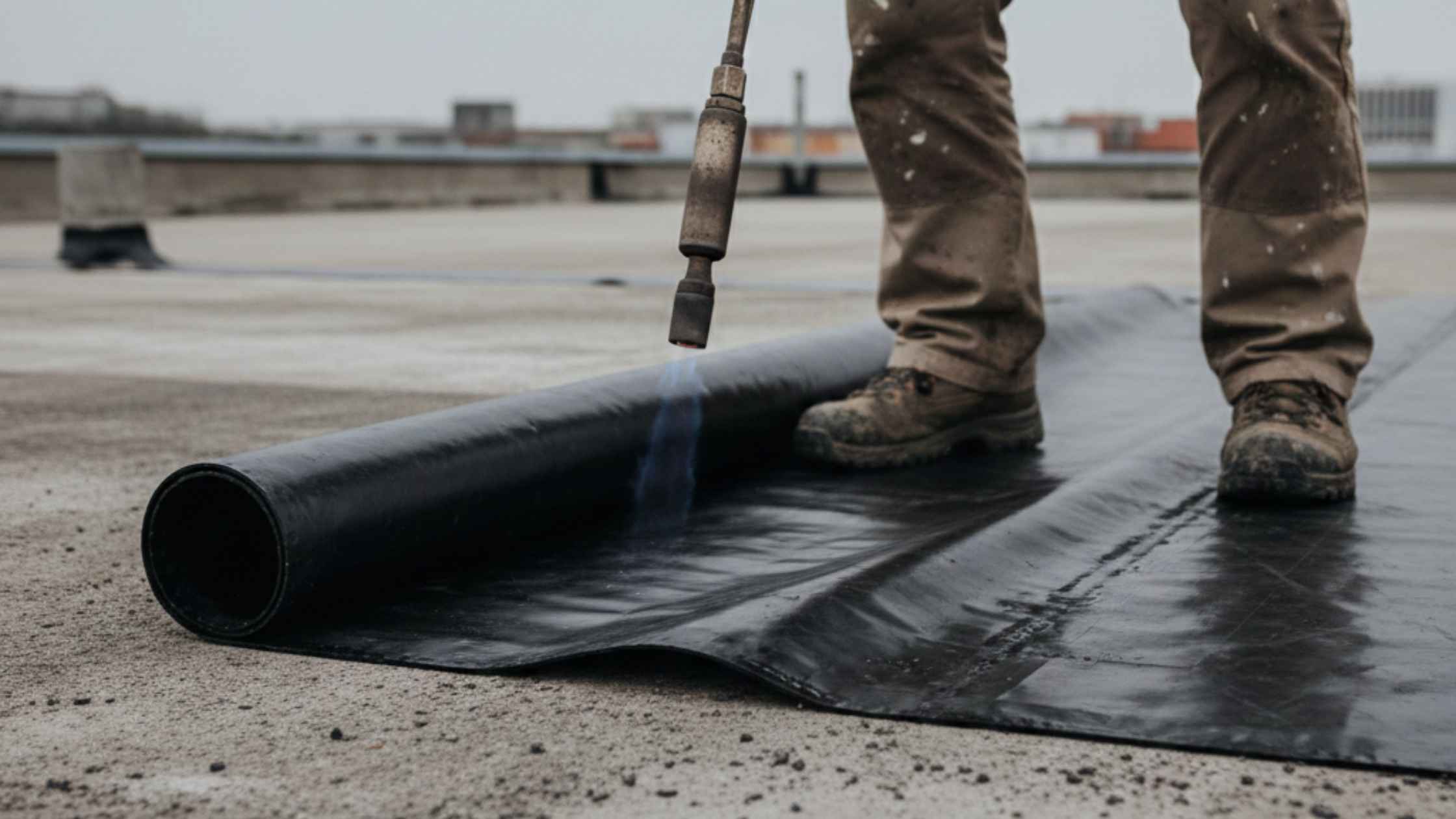
Choosing the right waterproofing membrane can make or break your construction project. The decision between liquid-applied waterproofing and pre-formed membrane systems directly impacts project timelines, installation, and long-term performance.
Understanding the key differences between liquid-applied waterproofing and pre-formed membrane systems helps to match the right waterproofing solution to the project requirements.
Continue reading to learn which waterproofing approach best suits your project and how to make an informed decision based on your unique site conditions.
Contents
- 1 What is Liquid-Applied Waterproofing?
- 2 What are Pre-Formed Waterproofing Membranes?
- 3 The Ultimate Comparison Framework
- 4 When to Choose Liquid Applied Waterproofing
- 5 When to Choose Pre-formed Membranes
- 6 Sunanda Global’s Waterproofing Solutions
- 7 Why Sunanda Global is Your Trusted Waterproofing Partner
- 8 FAQs
What is Liquid-Applied Waterproofing?
Liquid-applied waterproofing systems are seamless coatings applied in liquid form that cure to form a continuous, joint-free waterproof barrier over concrete elements like RC slabs etc.
Key Features:
- Applied by brush, roller, or spray
- Forms a monolithic membrane bonded directly to the substrate
- Eliminates seams and overlaps, reducing leakage risk
- Requires proper surface cleaning, priming, and controlled thickness as specified by the system
- Ideal for complex geometries, detailing, and repair works
These systems are particularly effective where sheet membranes are difficult to install or seamless protection is critical.
What are Pre-Formed Waterproofing Membranes?
Pre-formed waterproofing membranes are factory-manufactured sheets produced under controlled conditions to ensure consistent quality and thickness.
Key Features:
- Installed by cutting, placing, and fixing sheets over prepared surfaces
- Available in self-adhesive and heat-welded variants
- Suitable for large, flat, and uncomplicated areas
- Performance depends heavily on proper joint overlap and seam detailing
- Requires smooth and even substrates for effective installation
While reliable, these systems demand skilled workmanship to ensure watertight seams and long-term performance.
The Ultimate Comparison Framework
| Criteria | Liquid-Applied Waterproofing System | Pre-Formed Waterproofing System |
| Application Method & Complexity | Highly versatile: spray, brush, or roller applied. Seamlessly conforms to complex geometries and details. | Labour-intensive: requires precise cutting, positioning, and seam welding/sealing. Complex details demand skilled fabrication. |
| Substrate Requirements | Adapts well to irregular surfaces and can fill minor imperfections. Bonds directly to various materials. | Requires smooth, even substrates. Surface irregularities can cause bridging or poor adhesion, often needing extra preparation work. |
| Seamlessness & Leak Risk | Monolithic and jointless. It has no seams, which means no inherent weak points for water penetration. | Contains seams at overlaps and joints which could be potential failure points depending on installer skills. |
| Installation Speed | Installation is fast in open areas, but detailing and curing time between coats can extend the schedule. | Often faster on large, flat, unobstructed surfaces. Speed diminishes significantly with complexity and details. |
| Flexibility & Movement Accommodation | Has exceptional elasticity and crack-bridging (especially with PU/polyurea) and accommodates structural movement well. | Varies by material. Some are flexible (PVC, SBS), but others are less able to accommodate extreme movement, and seams can be stressed. |
| Aesthetic Finish | Cures to a smooth, uniform finish. It can be left exposed or topcoated for architectural aesthetics. | Has a sheet-like appearance with visible seams. Typically requires a protective cover or finish for exposed applications. |
| Thickness Control | Variable thickness is possible. It can build up coats in vulnerable areas. It requires skilled application for consistency. | It has a factory-controlled, consistent thickness. Ensures predictability but offers less flexibility for site-specific needs. |
| Repair & Maintenance | Straightforward and cost-effective.
Spot-repairs bond seamlessly with existing membrane. |
More complex,
requires patching or reworking seams. Repairs can be less reliable and more visible. |
When to Choose Liquid Applied Waterproofing
Liquid-applied waterproofing is ideal for:
- Complex and irregular surfaces
- Areas with multiple details
- Renovation and repair works
- Critical waterproofing zones
- Exposed applications
When to Choose Pre-formed Membranes
Pre-formed membranes are ideal for:
- Below-grade applications
- High hydrostatic pressure environments
- Projects with skilled membrane applicators
- Areas with minimal detailing
Sunanda Global’s Waterproofing Solutions
Liquid-Applied Solutions
- SUNKOTE WP+:
A user-friendly, UV-resistant elastomeric coating that provides a paintable, aesthetic finish for exposed applications.
Ideal For: Roofs (flat & sloping), external walls, chajjas, parapets, and sunken areas. Suitable for both new construction and repair.
Key Advantages: High-build, elastomeric formulation bridges minor cracks. Resistant to UV and fungal growth. Non-toxic and allows the substrate to breathe.
1.SUNPRUFE PU1K:
A single-component, high-elasticity membrane offering superior crack-bridging and long-term flexibility under thermal cycling.
Ideal For: Roof slabs, podiums, parking garages, bridge decks, plaza decks, landscaped areas, and water retaining structures (STPs, ETPs).
Key Advantages: Forms a seamless, strong, and thick flexible membrane without the need for reinforcement. Adheres strongly to concrete and remains flexible in extreme temperatures.
2. POLYALK WP:
A flexible, breathable coating that combines cement with advanced polymers. It is ideal for water-retaining structures and areas constantly exposed to moisture.
Ideal for: Bathrooms, toilets, potable water tanks, terrace reproofing and protecting structures against sulphate attacks.
Key Advantages: Alkaline and fully compatible with concrete. Can be applied on damp surfaces and in moist conditions. Provides a high-strength, impermeable co-matrix film.
Pre-Formed Sheet Waterproofing Membranes
3. SUNPRUFE:
A robust, self-adhesive HDPE membrane offering exceptional puncture resistance and long-term chemical stability for below-ground structures.
Ideal For: Foundation walls, basements, and sub-grade protection where resistance to ground chemicals and hydrostatic pressure is required.
Key Advantages: Integrated self-adhesive backing simplifies installation. Provides a high level of dimensional stability and durability.
4. SUNPRUFE SBS:
A flexible, self-adhesive bituminous membrane that offers proven waterproofing performance without the need for torch application.
Ideal For: Roof waterproofing, below-grade structures, and plazas. A safe and effective solution for a wide range of building types.
Key Advantages: Torch-free application enhances site safety. The SBS modification provides excellent flexibility and temperature resistance.
5. SUNPRUFE PVC
A flexible PVC waterproofing membrane with a signal layer for damage detection, designed for high-performance below-ground applications requiring hot air-welded seams.
Ideal For: Basement waterproofing, tunnel waterproofing, podiums and covered roofs, reservoirs, and canal lining.
Key Advantages: The signal layer indicates installation damage. Superior mechanical properties with excellent tensile strength and elongation. Double-welded joints allow pressure testing for quality assurance. Resistant to root penetration and maintains flexibility.
6. SUNPRUFE PO
A self-adhesive flexible polyolefin membrane with exceptional elongation and weather resistance, offering a fully bonded waterproofing solution for diverse applications.
Ideal For: Below-grade slabs, walls, prefabricated construction, roofing, retaining walls, tunnels, and potable/wastewater storage structures.
Key Advantages: Self-adhesive with outstanding elongation capacity and crack-bridging ability. UV-resistant with extreme temperature tolerance. Resistant to methane gas, radon, and aggressive soils. No lateral water migration or protection screed required.
Why Sunanda Global is Your Trusted Waterproofing Partner
With over 45 years of experience in Indian industrial construction, Sunanda Global stands as a trusted waterproofing company and manufacturer of ISO 9001:2015-certified, R&D-driven products. Our comprehensive range of liquid-applied waterproofing and pre-formed membrane systems addresses every construction waterproofing challenge with scientifically engineered solutions.
As the best waterproofing company, our low-VOC, environmentally conscious formulations deliver exceptional performance without compromising sustainability. Moreover, Sunanda Global provides complete support from initial technical consultation to project execution through trusted waterproofing contractors in Pune, Chennai, Hyderabad, Mumbai, and other major cities across India.
Choose Sunanda Global for waterproofing solutions that combine scientific innovation, proven durability, and reliable performance.
FAQs
Q1. What is liquid-applied waterproofing?
Liquid-applied waterproofing is a seamless membrane system where a liquid coating (like polyurethane, polyurea, or acrylic) is sprayed, rolled, or brushed onto a surface. It cures to form a continuous, joint-free, rubber-like barrier that bonds directly to the substrate.
Q2. What are the main advantages of liquid-applied waterproofing?
Its key advantages include seamless, monolithic coverage (eliminating leak-prone seams), excellent adaptability to complex shapes and details, strong crack-bridging ability, and the potential for a more aesthetic finish on exposed areas.
Q3. When should I choose a liquid-applied waterproofing membrane?
Choose liquid-applied systems for projects with complex geometries, areas with numerous penetrations, renovation work on irregular substrates, water-retaining structures, or where a seamless, exposed finish is desired (e.g., terraces, balconies).
Q4. When is a pre-formed membrane system a better choice?
Pre-formed sheets or rolls are often better for large, flat, and unobstructed surfaces like basement slabs or simple roofs. They are also preferred in environments with very high hydrostatic pressure or where robust, factory-controlled thickness and puncture resistance (e.g., HDPE) are critical.
Q5. Which system is faster to install?
Installation speed depends on the project. Pre-formed membranes can be quicker on large, simple, flat areas. Liquid-applied waterproofing can be faster for complex areas with many details, as it eliminates time-consuming cutting and seam welding, though it may require multiple coats and curing time.