

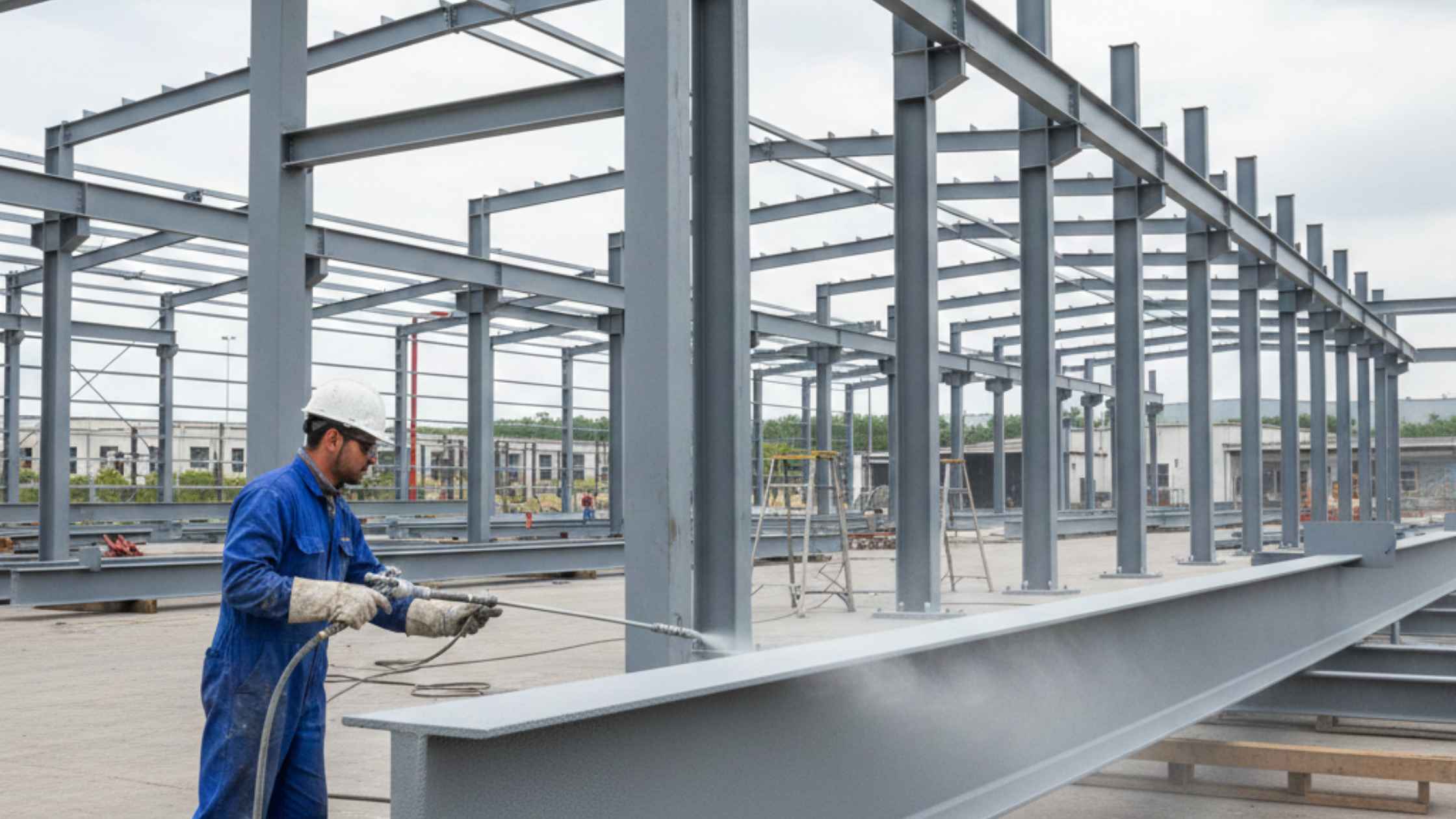
Pre-Engineered Buildings (PEBs) face constant exposure to corrosion, weathering, and chemical attack. Steel corrosion reduces structural lifespan and increases maintenance costs.
Protective coatings engineered specifically for steel structures solve this challenge. PEBs, which are factory-fabricated steel structures assembled on-site, offer speed and cost advantages but demand proper surface protection from day one.
Keep reading to discover which coating systems protect your PEB investment and give maximum durability.
Contents
- 1 Why do PEB Structures Need Protective Coatings?
- 2 What are the Types of Protective Coatings for PEB Structures?
- 3 What is the Selection Criteria for the Coating System?
- 4 What are the Best Practices for Application?
- 5 Sunanda Global’s Protective Coating Solutions for PEB
- 6 Making Your Decision with Sunanda Global
- 7 FAQs
- 8 Q1. Can I apply coatings to already-erected PEB structures?
- 9 Q2. What’s the difference between hot-dip galvanization and zinc-rich primers?
- 10 Q3. Do I need different coatings for primary and secondary members?
- 11 Q4. How do I maintain protective coatings on PEB structures?

Why do PEB Structures Need Protective Coatings?
Steel’s strength makes it ideal for construction, but its vulnerability to corrosion creates significant challenges.
Corrosion Threats
- Industrial areas introduce chemical pollutants and acidic atmospheres that continuously attack steel surfaces.
- Agricultural facilities deal with ammonia from livestock and constant moisture exposure
- High-humidity regions maintain conditions that promote rust formation year-round
- Coastal environments expose PEBs to salt spray and high humidity. The chloride ions accelerate steel corrosion dramatically.
Consequences of Inadequate Protection
- Structural integrity compromise poses safety risks
- Progressive corrosion reduced load-bearing capacity over time
- Expensive repairs and production downtime disrupt operations
- Reduced building lifespan means premature replacement costs
PEBs are a significant capital investment. Proper protective coatings extend service life and reduce long-term maintenance costs by preventing corrosion rather than treating it.
What are the Types of Protective Coatings for PEB Structures?
Different coating types serve specific functions in steel protection.
Primer Coatings
- Zinc-rich primers offer cathodic (corrosion-control) protection for structural steel, where the zinc corrodes first to shield the base metal from corrosion.
- Epoxy primers deliver superior adhesion and chemical resistance for demanding environments.
Intermediate/Build Coatings
- High-build epoxy coatings create barrier protection against moisture and chemicals. These thick films fill surface irregularities.
- Micaceous iron oxide (MIO) coatings combine UV resistance with moisture barriers through overlapping plate-like particles.
Topcoat/Finish Coatings
- Polyurethane coatings resist UV radiation while maintaining colour and gloss. They provide aesthetic finishes for exposed members.
- Acrylic coatings offer moderate weather resistance with anti-carbonation properties.
Specialized Options
- Hot-dip galvanization applies thick zinc coatings through immersion in molten zinc. This provides high corrosion protection and a strong bond, and also provides passive fire protection to steel structures.
- Intumescent paints expand when exposed to heat, protecting steel during fire events
What is the Selection Criteria for the Coating System?
Matching the coatings to your specific conditions ensures optimal protection
- Environmental factors: Coastal locations demand zinc-rich primers with epoxy or polyurethane topcoats. Industrial sites need chemical-resistant systems.
- Application requirements: Primary structural steel needs robust protection. Secondary members may accept different specifications.
- Performance expectations: A 15-year requirement differs from a 30-year specification. It is essential to consider the project specifications and performance requirements when selecting the right system.
- Building function: Warehouses prioritize cost-effective protection. Manufacturing facilities may need chemical resistance. Commercial buildings require aesthetic finishes.
What are the Best Practices for Application?
Proper application determines whether coatings perform as specified.
Factory Application
- A controlled environment ensures consistent quality
- Automated application delivers uniform thickness
- Faster curing times accelerate production
- Best for primary structural members
On-Site Touch-Up
- Field-welding and bolting operations damage factory-applied coatings
- Fastener points need immediate protection
- Transport damage requires prompt attention
- Focus on maintaining coating integrity
Surface Preparation
- Surface preparation is crucial for coating system success
- Blast cleaning achieves optimal adhesion
- Remove all mill scale, rust, and contaminants before coating application
Sunanda Global’s Protective Coating Solutions for PEB
For Structural Steel
SUNEPOXY ZP PRIMER
Protects structural steel and pipes, tank exteriors, bridges, and offshore platforms. Excellent corrosion resistance with superior adhesion to steel. Compatible with multiple topcoats. Ideal for coastal and industrial environments.
SUNEPOXY MIO
This Micaceous Iron Oxide (MIO) epoxy coating is designed for harsh environments like refineries and petrochemical facilities. Superior UV and moisture barrier with excellent abrasion resistance. Suits offshore structures, chemical plants, and marine environments.
SUNPUGARD
Final protective coating with aesthetic appeal. UV-resistant formulation maintains colour and gloss. Excellent chemical and abrasion resistance. Perfect topcoat for exposed structural members.
For Surface Preparation
RUSTICIDE
This powerful treatment removes rust and passivates steel. It is ideal for structural steel, tanks, and pipelines, and it ensures a corrosion-free foundation for long-term protection. Conforms to IS 9077.
Making Your Decision with Sunanda Global
With 45+ years of experience in Indian industrial construction, Sunanda Global stands as the best waterproofing company and manufacturer of ISO 9001:2015-certified, R&D-driven products. Our protective coating solutions cater to diverse sectors, from manufacturing to petrochemicals, designed to meet safety standards while promoting sustainability.
Our trained applicators and waterproofing contractors in Delhi and across India ensure proper installation and performance. Sunanda Global provides complete support from technical specification assistance to vetted application partners.
Contact Sunanda Global today for expert guidance and steel protection that combines scientific innovation with reliable long-term performance.
FAQs
Q1. Can I apply coatings to already-erected PEB structures?
Yes, though surface preparation becomes more challenging. Proper blast cleaning requires experienced contractors for field application.
Q2. What’s the difference between hot-dip galvanization and zinc-rich primers?
Hot-dip galvanization applies a thick zinc through immersion in molten zinc. Zinc-rich primers apply zinc particles in paint form, which is easier for complex shapes.
Q3. Do I need different coatings for primary and secondary members?
Not necessarily. The same system often works for both, but specifications may allow economical systems for secondary members.
Q4. How do I maintain protective coatings on PEB structures?
Annual visual inspections identify damaged areas. Prompt touch-up prevents corrosion spread. For basic systems, recoating every 10-15 years will ensure maximum protection.