

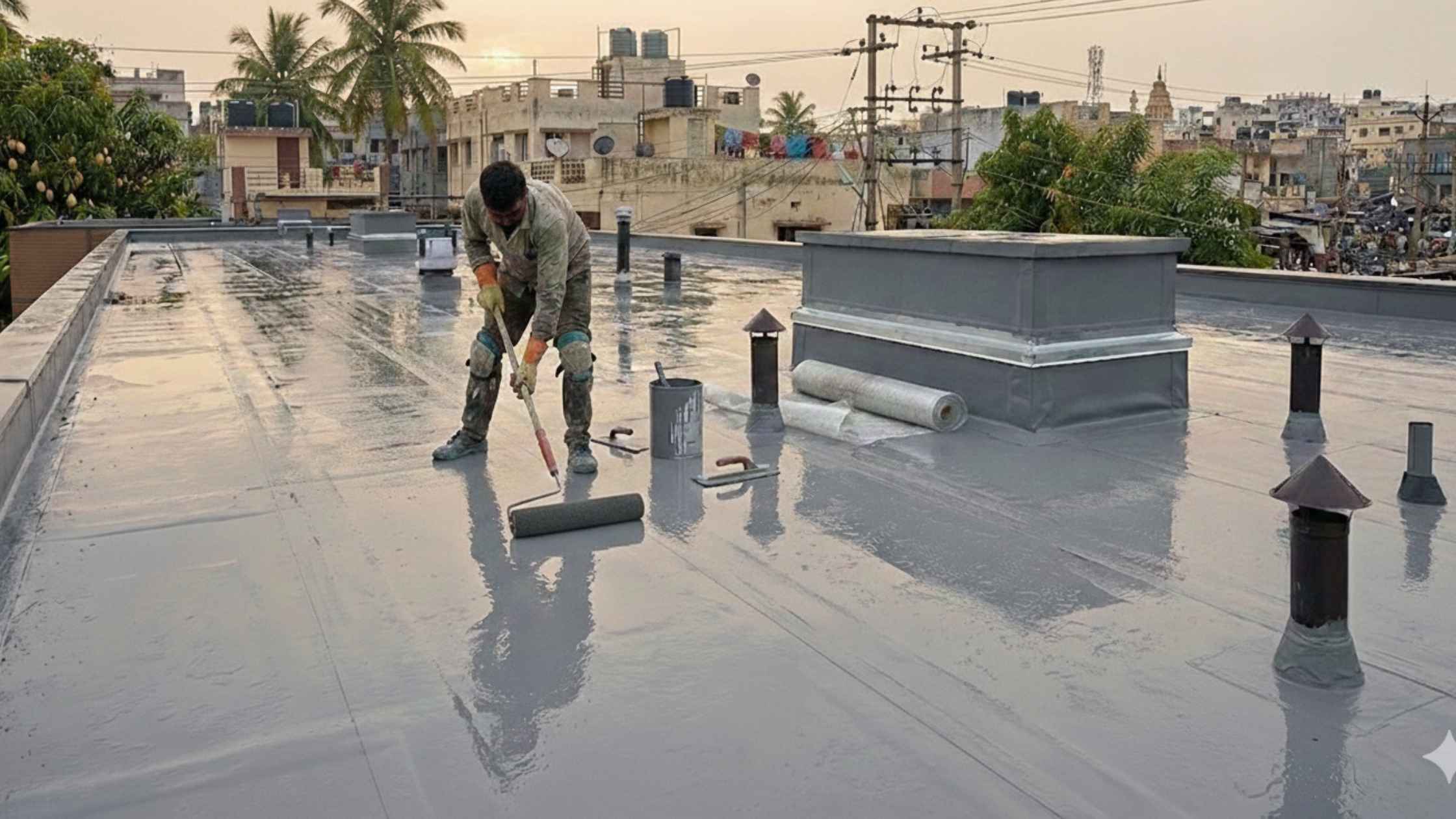
Green roofs and solar panel installations transform conventional rooftops into productive assets. However, these systems create unique challenges for the roof membrane beneath them that standard waterproofing chemicals cannot handle.
Traditional roof waterproofing systems fail under the demanding conditions these applications create. Root penetration, constant moisture, equipment loads, and penetrations compromise the protection designed for weather exposure.
This guide explains what roof membrane properties green roofs and solar installations require, and which systems deliver decades of reliable performance.
Contents
- 1 Understanding the Challenge: Why Standard Membranes Fail
- 2 What are the Essential Properties for Green Roof Membranes?
- 3 What are the Critical Requirements for Solar Installation Membranes?
- 4 What are the Common Membrane Failures and How to Prevent Them?
- 5 What are the Best Installation Practices?
- 6 Choose Sunanda Global’s Roof Membrane Solutions
- 7 Making Your Decision with Sunanda Global
- 8 FAQs
- 9 Q1. What makes polyurethane membranes better for green roofs than other options?
- 10 Q2. Can the same roof membrane work for both green roofs and solar panels?
- 11 Q3. Do I need a separate root barrier with polyurethane membranes?
- 12 Q4. What is the single most important property for a green roof membrane?

Understanding the Challenge: Why Standard Membranes Fail
Green roofs expose membranes to constant moisture, unlike conventional roofs that dry between rain events. Plant roots actively seek water, penetrating any weakness in the waterproofing. Soil produces organic acids that degrade certain materials.
Solar installations create concentrated heat zones, and mounting system penetrations become potential leak points. The membrane must be durable for the long term without the need for repairs since panel removal proves extremely expensive.
Standard roof coating systems cannot survive these specialized demands.
What are the Essential Properties for Green Roof Membranes?
Root Resistance
Roots exploit any weakness, such as seams, cracks, or permeable areas. The membrane must physically resist root penetration or incorporate chemical root barriers.
Testing per FLL guidelines (the German guidelines for the planning, execution, and upkeep of green-roof sites) verifies true root resistance. Unproven systems allow roots to penetrate within years, causing expensive damage invisible until serious leaks develop.
Seamless Application
Seams represent the weakest points for root attack. Liquid-applied systems create monolithic membranes without joints. This eliminates the most common green roof failure mode.
Sheet systems require meticulous seam installation and often need supplemental root barriers.
Flexibility and Chemical Resistance
Roof membrane must accommodate structural movement while resisting organic acids from decomposition, fertilizers, and pH variations in the growing medium. Constant moisture exposure demands adhesion that persists despite never drying.
What are the Critical Requirements for Solar Installation Membranes?
Penetration Management
Solar mounting systems typically require roof penetrations for structural attachment. Each represents a potential leak point. The membrane must integrate with flashing systems, maintaining waterproof integrity.
Ballasted systems without penetrations still create concentrated point loads that the membrane must handle.
High-Temperature Stability
Solar panels reflect and concentrate heat onto certain roof areas. These zones can reach 80-90°C in the summer sun. The roof waterproofing must maintain its properties despite this thermal stress.
Long-Term Accessibility Challenges
The membrane must match or exceed solar panel lifespan. Accessing waterproofing for repair requires panel removal which is extremely costly and disruptive. Initial system selection becomes critical since replacement proves impractical.
What are the Common Membrane Failures and How to Prevent Them?
| Failure Type | The Problem | Prevention Method |
| Root penetration through seams | Sheet membrane seams create weak points vulnerable to root invasion | Specify seamless liquid-applied systems like Sunanda Global’s SUNPRUFE PU1K |
| Adhesion loss from moisture | Some adhesives degrade in constant dampness, causing membrane delamination | Use moisture-tolerant polyurethane systems with reliable bonding |
| Thermal degradation under solar panels | Extreme heat under panels can soften or break down temperature-sensitive membranes | Select membranes with high-temperature stability |
| Punctures during installation | Installing overlying components like drainage layers, soil, and plants can puncture an unprotected membrane | Use high-puncture-resistance membranes and install protective board layers |
What are the Best Installation Practices?
Surface Preparation
Concrete substrates must be fully cured, clean, dry, and free from contamination. Repair all cracks and defects. Existing roof surfaces require the removal of loose material and failed coatings.
Detailed Work
Extra care at all penetrations and edges proves critical. Build up membrane thickness at vulnerable points. Ensure complete coverage of details.
Protection Layer
After the membrane cures, install the protection board before placing components. This prevents punctures during green roof installation and distributes point loads. For green roofs, add a drainage layer, filter fabric, and growing medium per landscape specifications. For solar, provide protection at mounting points.
Quality Control
Monitor weather conditions constantly. Verify proper thickness with wet film gauge. Ensure complete coverage and flood test before covering, if possible.
Choose Sunanda Global’s Roof Membrane Solutions
SUNPRUFE PU1K – Single-Component Polyurethane Membrane
SUNPRUFE PU1K delivers the ideal solution for these specialized applications. This single-component polyurethane system addresses every critical requirement.
Key Benefits:
- Single component: no mixing errors, easy to apply, and ready to use
- Provides seamless waterproofing
- A strong, thick, and flexible membrane
- Adheres strongly to the concrete and remains flexible under extreme temperatures
Making Your Decision with Sunanda Global
With over 45 years of expertise, Sunanda Global leads in innovation in construction chemical coatings. We invest 5% of annual revenue in R&D, focusing 60% of our efforts on LEED-compliant and eco-friendly products.
As a leading waterproofing company, our polyurethane roof membrane solutions, SUNPRUFE PU1K is seamless, root-resistant, long-lasting systems that match your building’s lifespan. With us, you can expect reliable on-site execution through trusted waterproofing contractors in Bangalore, Mumbai, Chennai, Delhi, and other major cities.
Contact Sunanda Global for expert consultation on roof membrane solutions for your green roof or solar installation project.
FAQs
Q1. What makes polyurethane membranes better for green roofs than other options?
Polyurethane systems offer seamless application, eliminating seam vulnerability to roots, superior chemical resistance to soil acids, excellent flexibility under constant moisture, and maximum durability.
Q2. Can the same roof membrane work for both green roofs and solar panels?
Yes. SUNPRUFE PU1K excels at both applications, providing root resistance for green roofs and temperature stability plus long service life for solar.
Q3. Do I need a separate root barrier with polyurethane membranes?
SUNPRUFE PU1K’s dense, seamless polyurethane film provides inherent root resistance. Additional root barriers generally aren’t necessary, but can be specified for extra protection in intensive green roofs.
Q4. What is the single most important property for a green roof membrane?
Root resistance is the single most important property because plant roots actively seek water, and a truly root-resistant membrane, ideally tested to standards like FLL guidelines, is non-negotiable to prevent hidden damage and leaks.