

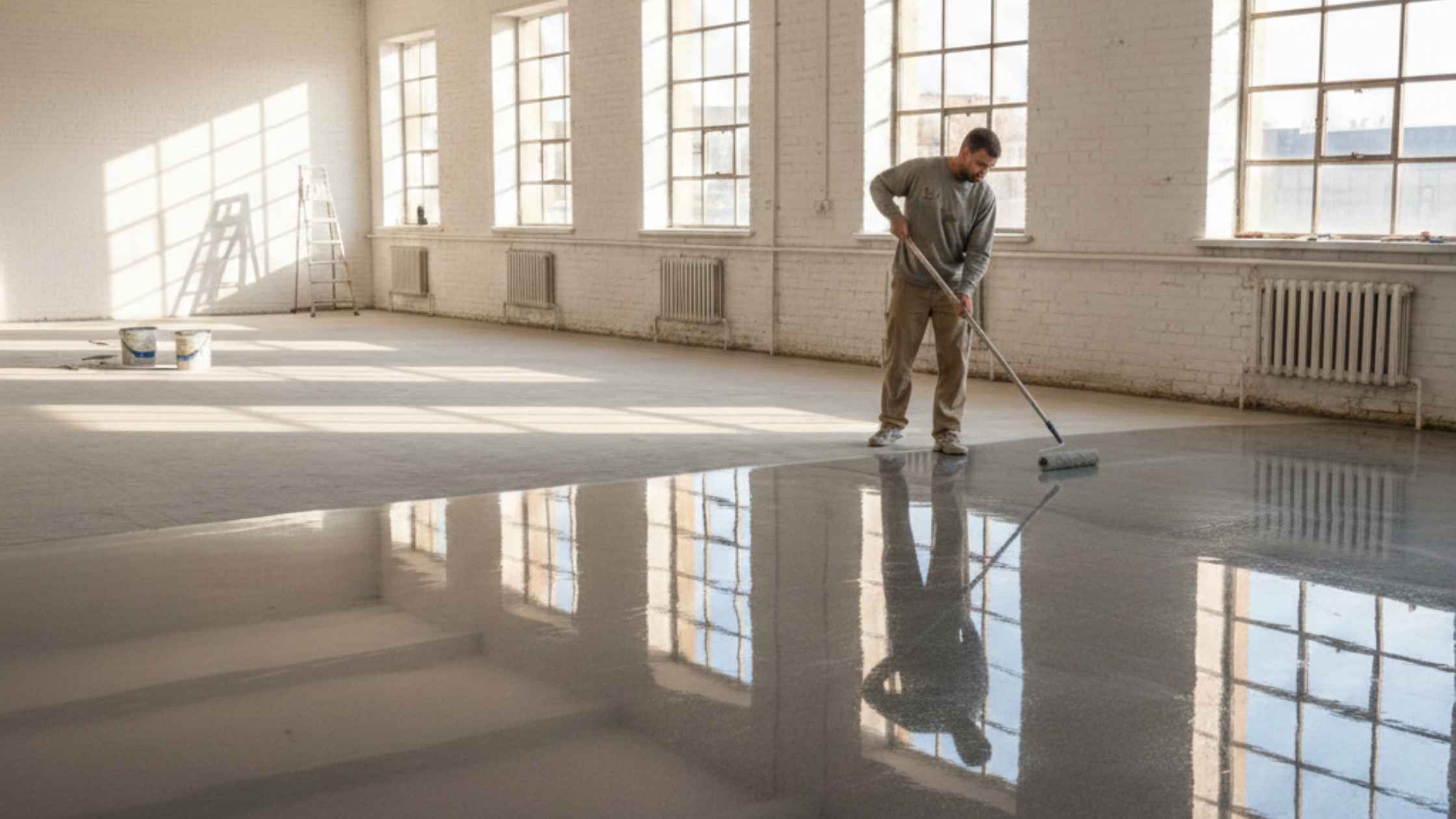
Is your construction project being held back by misconceptions about flooring solutions? Despite its proven track record in delivering durable, seamless surfaces, self-levelling epoxy flooring continues to be surrounded by myths that prevent architects, developers, and contractors from leveraging its full potential. These misconceptions often lead to choosing inferior alternatives that compromise both performance and long-term cost-efficiency.
In this article, we’ll debunk the top five myths about self-levelling epoxy flooring and reveal the truth behind this versatile construction solution.
Contents
- 1 Myth #1: Self-Levelling Epoxy is Only for Industrial Buildings
- 2 Myth #2: Self-Levelling Epoxy is too Expensive
- 3 Myth #3: Installation is Too Complicated for Most Projects
- 4 Myth #4: Epoxy Floors Yellow and Lose Shine Quickly
- 5 Myth #5: Self-Levelling Epoxy Can’t Handle Moisture
- 6 Sunanda Global’s Solutions for Self-Levelling Epoxy Flooring
- 7 Why Sunanda Global Is Your Trusted Partner for Epoxy Flooring Solutions
- 8 FAQs
- 9 Q1. Is self-levelling epoxy really just for factories and warehouses?
- 10 Q2. Can epoxy flooring be installed if there are moisture concerns in the substrate?
- 11 Q3. Will an epoxy floor turn yellow and lose its shine under sunlight?
- 12 Q4. What is the most critical step for a successful epoxy floor installation?

Myth #1: Self-Levelling Epoxy is Only for Industrial Buildings
The Myth
Many believe that epoxy flooring is exclusively designed for factories, warehouses, and heavy-duty industrial environments. This perception stems from epoxy’s strong association with manufacturing plants and storage facilities where heavy machinery and extreme wear are common.
The Reality
While self-levelling epoxy flooring has indeed been a staple in warehouses and manufacturing facilities, its application extends far beyond industrial settings. Modern epoxy formulations offer aesthetic versatility alongside their functional benefits, making them suitable for healthcare facilities, educational institutions, hospitality venues, and even high-end residential projects.
Myth #2: Self-Levelling Epoxy is too Expensive
The Myth
The upfront cost of epoxy flooring installation is often higher than traditional flooring options like tiles, vinyl, or polished concrete. This initial price point leads many decision-makers to dismiss epoxy as a premium option that doesn’t fit in with the budget.
The Reality
When evaluating flooring costs, looking only at initial installation prices creates a misleading picture. Self-levelling epoxy flooring delivers exceptional value when you factor in its longevity, minimal maintenance requirements, and reduced lifecycle costs.
Myth #3: Installation is Too Complicated for Most Projects
The Myth
There is a perception that self-levelling epoxy flooring involves overly complex procedures, specialized equipment, and high execution risk. Concerns about bubbling, uneven finishes, or premature failure often discourage project teams from considering epoxy systems.
The Reality
Successful installation depends on proper substrate assessment, moisture testing, surface profiling, and controlled mixing ratios. These are standard practices for experienced applicators.
Modern self-levelling formulations are engineered to flow and settle uniformly, reducing application inconsistencies when correct procedures are followed. With professional surface preparation and trained installers, epoxy flooring becomes a controlled, repeatable process suitable for commercial, institutional, and industrial projects.
Myth #4: Epoxy Floors Yellow and Lose Shine Quickly
The Myth
A common concern is that epoxy floors will yellow and lose their gloss, especially in areas with natural sunlight. The assumption is that all epoxy systems are prone to aesthetic deterioration regardless of quality or application.
The Reality
Conventional epoxy resins are susceptible to discolouration over time. However, performance depends on formulation and system design. Moder
Modern high-performance epoxy systems incorporate advanced additives and topcoats that resist yellowing and maintain their appearance for years. In sun-exposed areas, UV-resistant or polyurethane-modified topcoats are commonly specified to ensure aesthetic longevity. It is important to select the right system for the exposure conditions.
Myth #5: Self-Levelling Epoxy Can’t Handle Moisture
The Myth
One of the most persistent concerns is that epoxy flooring will fail in areas with moisture presence, such as basements, ground floors, or humid climates, leading to bubbling, delamination, or surface defects.
The Reality
Moisture-related failures in epoxy flooring typically result from improper substrate preparation or using inappropriate products for the conditions, not from inherent limitations of epoxy technology itself. In fact, certain epoxy systems are specifically engineered to perform in high-moisture environments.
Sunanda Global’s Solutions for Self-Levelling Epoxy Flooring
Sunanda Global offers a comprehensive range of self-levelling epoxy flooring solutions that directly address these common concerns while delivering superior performance across diverse applications.
SUNEPOXY PU
This premium polyurethane-modified epoxy system provides exceptional chemical and abrasion resistance. It is ideal for areas where extreme hygienic, abrasion, and chemical spillage pose the risk of floor erosion.
SUNEPOXY SL
This specialized self-levelling epoxy creates a perfectly smooth base layer, which is non-shrink and non-solvent. It provides excellent adhesion with superior abrasion and chemical resistance, making it ideal for clean rooms, laboratories and plant rooms.
SUNCEM ECC
This epoxy cementitious self-levelling moisture barrier has high compressive strength and is a solvent-free, water-based formulation. It is seamless and has good chemical and oil resistance, which makes it perfect for clean rooms, floor topping on non-ventilated, damp surfaces and hospitals.
Why Sunanda Global Is Your Trusted Partner for Epoxy Flooring Solutions
With over 45 years of experience in Indian industrial construction, Sunanda Global leads in innovation in construction chemical coatings. We invest 5% of annual revenue in R&D, focusing 60% of our efforts on LEED-compliant and eco-friendly products. We also hold ISO 9001:2015 certification.
As the best waterproofing company in India, our low-VOC, environmentally conscious water leakage solutions deliver top performance. Moreover, Sunanda Global provides full support: from technical advice to vetted partners. With us, you can expect reliable on-site execution through trusted waterproofing contractors in Bangalore, Chennai, Hyderabad, Mumbai, and other major cities.
Contact Sunanda Global for self-levelling epoxy flooring solutions that combine scientific innovation, proven durability, and reliable performance backed by decades of expertise.
FAQs
Q1. Is self-levelling epoxy really just for factories and warehouses?
While renowned for industrial durability, modern epoxy systems offer aesthetic versatility with various colours and finishes, making them suitable for healthcare, retail, commercial offices, and even high-end residential applications.
Q2. Can epoxy flooring be installed if there are moisture concerns in the substrate?
Yes, with the right system and preparation. High-performance epoxy products and proper substrate repair materials are specifically engineered for moisture-prone conditions. Success also depends on a professional assessment, surface preparation, and correct product selection.
Q3. Will an epoxy floor turn yellow and lose its shine under sunlight?
This is a common concern based on older products. Premium, modern epoxy formulations, such as polyurethane-modified epoxies, incorporate UV-stable additives and topcoats that resist yellowing and maintain their gloss appearance for years, even in sun-exposed areas.
Q4. What is the most critical step for a successful epoxy floor installation?
Professional surface preparation is paramount. The concrete substrate must be clean, sound, and properly profiled to ensure a strong bond. Skipping or rushing this step is a leading cause of future failures like delamination or bubbling.