

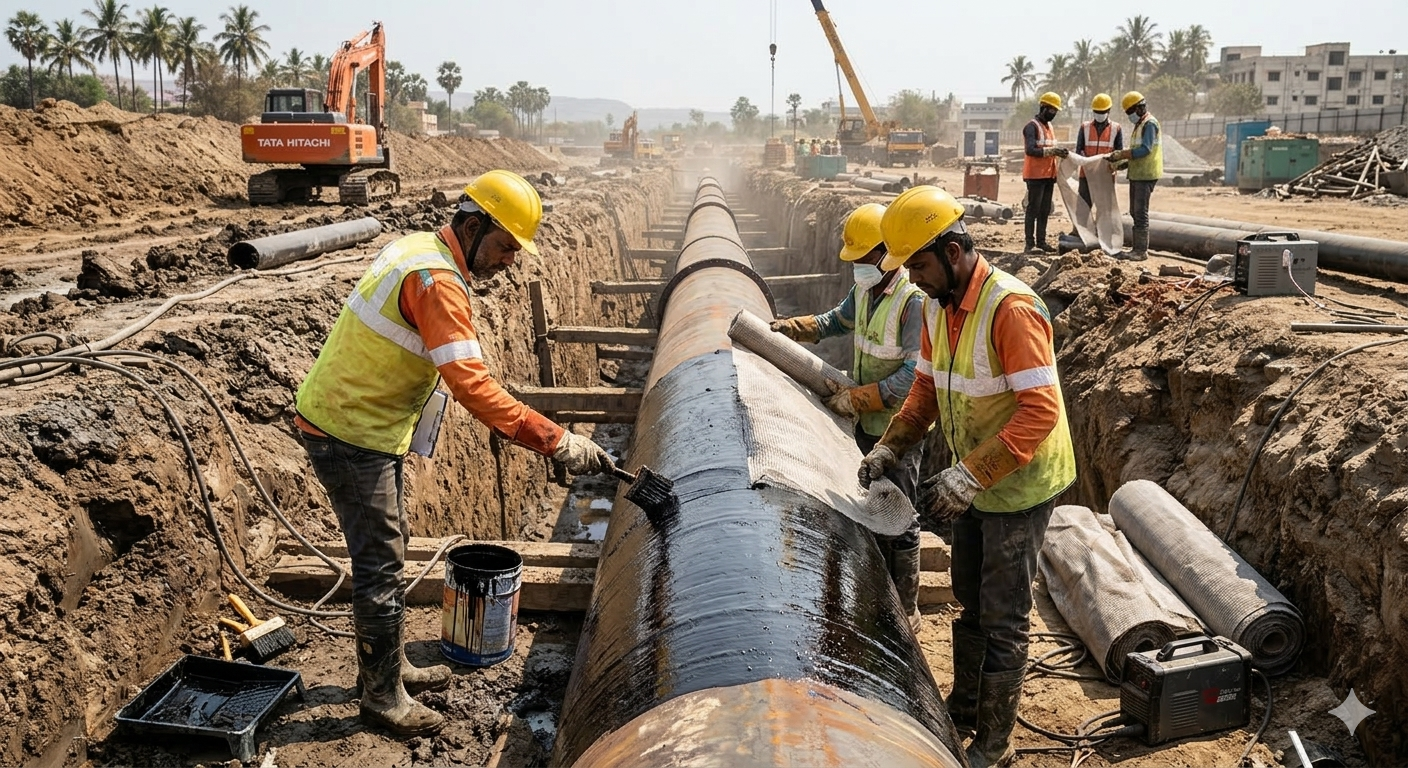
Why do some mild steel pipelines fail within a few years while others serve reliably for decades? The difference lies not in the steel quality but in the protective systems applied to prevent corrosion and degradation.
MS (Mild Steel) pipe coatings are specialized protective layers applied to steel pipelines to prevent corrosion, chemical attack, and environmental degradation. These systems are essential across municipal water systems, industrial facilities, oil and gas pipelines, and commercial buildings. Without adequate protection, exposed mild steel deteriorates rapidly.
This blog helps property owners, contractors, facility managers, and industrial operators understand how MS pipe coatings are crucial to protecting infrastructure investments and preventing premature failures.
Contents
- 1 What are MS Pipe Coatings?
- 2 Why Unprotected Mild Steel Fails Prematurely
- 3 How Protective Coatings Work as Corrosion Barriers
- 4 What are the Types of Protective Systems?
- 5 Sunanda Global’s Comprehensive MS Pipeline Coating Solutions
- 6 Why Choose Sunanda Global for Pipeline Protection?
- 7 FAQs
- 8 Q1. Can coatings be applied to already corroded pipes?
- 9 Q2. Can I apply pipe coatings myself, or do I need contractors?
- 10 Q3. What surface preparation is required before coating application?
- 11 Q4. How do I maintain coated pipelines for maximum life?
- 12 Q5. What causes pipeline coatings to fail prematurely?

What are MS Pipe Coatings?
MS pipes are carbon steel pipes with low carbon content. They are malleable, cost-effective and weldable, which make them the most widely used piping material across industries from water distribution and plumbing to industrial process lines and oil transportation.
MS pipe coatings are engineered barrier systems applied to mild steel pipelines to isolate the metal from corrosive environments. These protective layers prevent direct contact between steel surfaces and elements that cause deterioration.
Advanced systems combine multiple layers, each serving specific functions:
- Primers ensure adhesion and provide initial corrosion resistance
- Intermediate coats build thickness and barrier properties
- Topcoats deliver final protection against specific challenges
Unlike simple paints, industrial pipeline coatings are formulated to withstand extreme conditions, including soil burial, chemical exposure, temperature fluctuations, and mechanical stress.
Why Unprotected Mild Steel Fails Prematurely
Mild steel’s vulnerability stems from its chemical composition. When exposed to moisture and oxygen, iron oxidizes rapidly, forming rust. This electrochemical process accelerates in certain conditions, causing rapid deterioration.
Key Corrosion Mechanism:
- Atmospheric Corrosion: Exposed steel in humid environments develops rust within days. Coastal areas with salt-laden air and industrial zones with pollutants accelerate this dramatically.
- Soil Corrosion: Underground pipelines face hostile environments with soil moisture, varying pH levels, and dissolved salts.
- Chemical Attack: Acids, alkalis, and industrial solvents corrode unprotected steel within months, causing leaks and structural failure.
- Galvanic Corrosion: When steel contacts dissimilar metals, accelerated corrosion occurs at the junction
How Protective Coatings Work as Corrosion Barriers
Effective pipeline coatings function through multiple protective mechanisms working simultaneously to prevent steel degradation.
Key Protection Mechanisms:
- Physical Barrier Protection: Creates an impermeable layer blocking moisture, oxygen, and corrosive agents from reaching steel surfaces
- Adhesion and Continuity: Bonds to steel without pinholes or weak spots. A single breach allows localized corrosion that undermines surrounding areas.
- Chemical Resistance: Specialized formulations resist acids, alkalis, solvents, or petroleum products the pipeline encounters,
- Flexibility and Movement Accommodation: Pipelines expand with temperature changes and ground settlement, and coatings must flex without cracking.
- Cathodic Protection Enhancement: Some coatings work with cathodic protection systems, providing electrochemical corrosion prevention alongside the physical barrier.
What are the Types of Protective Systems?
Different pipeline environments require specific coating technologies for optimal protection.
Common Coating Systems:
- Epoxy Systems: Coal-tar epoxy and pure epoxy dominate underground pipeline protection, offering excellent adhesion and chemical resistance.
- Polyurethane Coatings: Deliver superior UV resistance and flexibility for above-ground pipelines exposed to sunlight. Ideal for visible installations requiring appearance retention.
- Fusion-Bonded Epoxy (FBE): Factory-applied powder coatings create exceptionally uniform protection. Dominate oil and gas transmission but require specialized facilities.
- Multi-Layer Systems: Combine coating types to leverage each material’s strengths. Epoxy primers provide adhesion, intermediate coats build thickness, while polyurethane topcoats deliver UV protection.
- Tape Wrapping Systems: Specialized adhesive tapes offer cost-effective protection for field joints, repairs, and smaller-diameter pipes.
Sunanda Global’s Comprehensive MS Pipeline Coating Solutions
For External corrosion protection for underground buried pipes
- RUSTICIDE
A rust remover and passivator, it is ideal for embedded steel in repairable structures and other structural members. It performs rust removal and rust prevention in one operation in mild conditions.
- SUNEPOXY COALTAR
A two-component tar-modified epoxy coating that protects steel in corrosive environments. It is used on steel surfaces in sewage plants, paper mills, etc..
For internal pipe lining
SUNEPOXY 100
A non-toxic, solvent-free, high-build pure epoxy coating which protects internal surfaces of pipelines. It has excellent adhesion and chemical and solvent resistance.
For UV-resistant topcoat protection for above-ground pipes
SUNPUGARD
A two-component, UV-resistant, polyurethane coating that is used for exteriors and interiors. It has excellent chemical and abrasion resistance.
Why Choose Sunanda Global for Pipeline Protection?
With over 45 years of experience in Indian industrial construction, Sunanda Global leads in innovation in construction chemical coatings. We invest 5% of annual revenue in R&D, focusing 60% of our efforts on LEED-compliant and eco-friendly products. We also hold ISO 9001:2015 certification.
As the best waterproofing company in India, our low-VOC, environmentally conscious water leakage solutions deliver top performance. Moreover, Sunanda Global provides full support: from technical advice to vetted partners. With us, you can expect reliable on-site execution through trusted waterproofing contractors in Delhi, Chennai, Hyderabad, Mumbai, Bangalore and other major cities.
Contact Sunanda Global for pipeline coatings that combine scientific innovation, proven durability, and reliable performance backed by decades of expertise.
FAQs
Q1. Can coatings be applied to already corroded pipes?
Yes, with proper surface preparation. Rust must be removed through abrasive blasting, followed by primer application. However, severely corroded pipes with structural compromise require replacement, not coating.
Q2. Can I apply pipe coatings myself, or do I need contractors?
Small above-ground projects can be applied easily with the right equipment and technique. Underground pipelines, internal linings, and large installations require professional contractors to ensure proper surface preparation, application, and quality control.
Q3. What surface preparation is required before coating application?
Steel must be abrasive blasted to remove all rust, mill scale, and contaminants. Degreasing removes oils. Proper preparation ensures coating adhesion and long-term performance.
Q4. How do I maintain coated pipelines for maximum life?
Conduct annual visual inspections to identify damage. Repair mechanical damage promptly before corrosion starts. For underground pipes, cathodic protection monitoring ensures continued effectiveness. Avoid excavation damage during nearby construction activities.
Q5. What causes pipeline coatings to fail prematurely?
Poor surface preparation, inadequate coating thickness, application under improper conditions (temperature, humidity), mechanical damage during installation, and coating incompatibility with service conditions are the main causes of failures. Proper specification prevents these issues.