

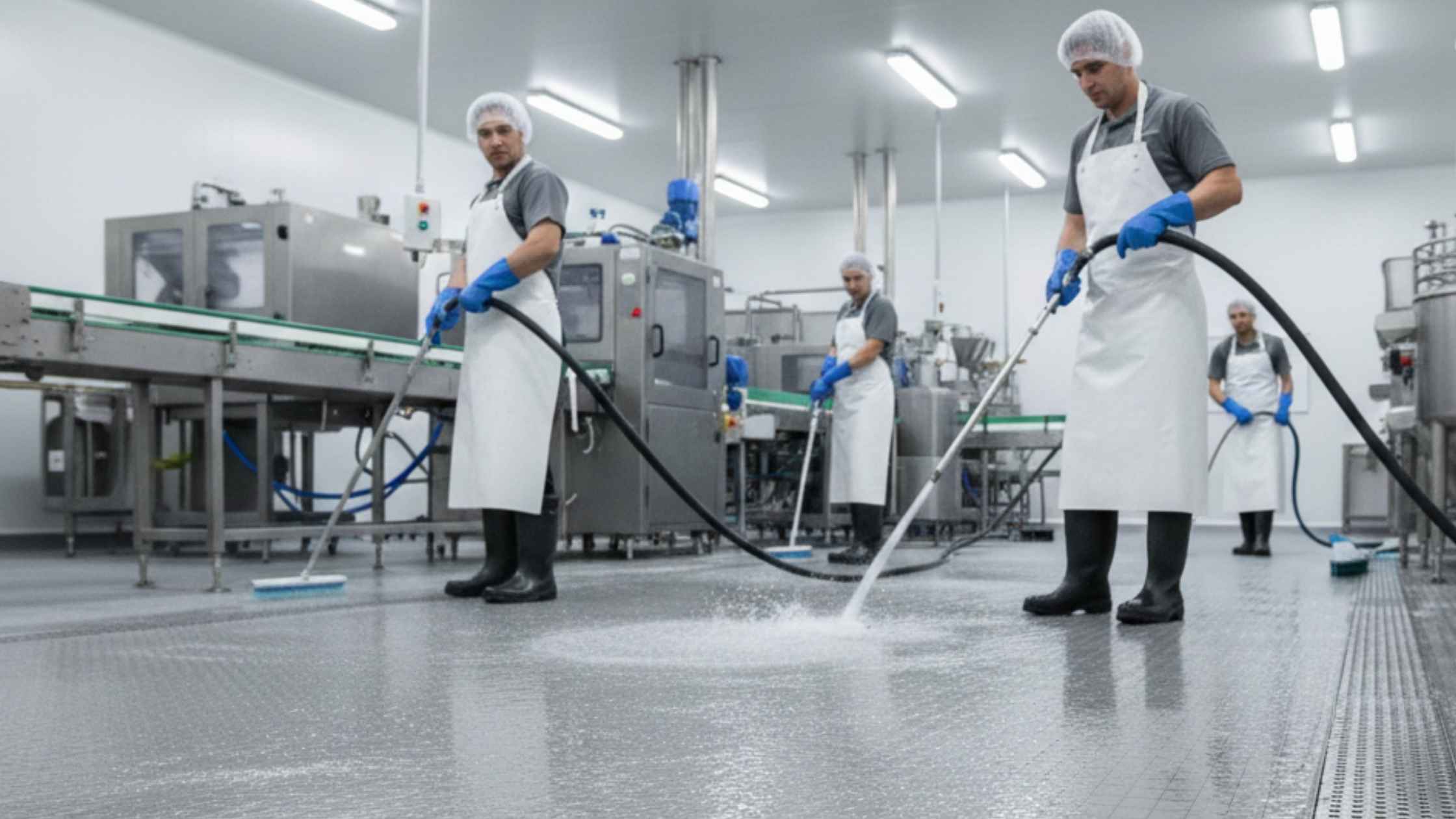
A single slip accident in a food processing facility can cost significantly more than the injured worker’s immediate medical expenses. Production lines halt. Insurance claims escalate. Regulatory investigations commence. The total financial impact often reaches hundreds of thousands of dollars from one preventable incident.
Slip-resistant flooring addresses this critical safety and operational challenge in food processing environments where wet conditions, organic materials, and strict hygiene requirements create unique demands.
Contents
- 1 What are the Slip Hazard Risks in Food Processing?
- 2 What are the Regulatory and Hygiene Requirements?
- 3 5 Essential Properties of Effective Food Processing Flooring
- 4 What are the Implementation Best Practices?
- 5 What is the Long-Term Value of Slip-Resistant Flooring?
- 6 Choose Sunanda Global’s Slip-Resistant Flooring Solutions
- 7 Making Your Decision with Sunanda Global
- 8 Frequently Asked Questions

What are the Slip Hazard Risks in Food Processing?
Food processing plants have inherently hazardous floors because of constant wetness from cleaning operations, oils, fats, and proteins from food products, condensation, and high-pressure washdowns. These conditions make standard flooring dangerously slippery.
The consequences are severe:
- Slips and falls are the leading cause of injury
- Each incident halts production for cleanup and investigation
- Injuries lead to understaffing, lower morale, and eroded work confidence
What are the Regulatory and Hygiene Requirements?
Food processing facilities must meet strict standards and local health codes that mandate specific flooring characteristics beyond basic slip resistance.
Key requirements include:
- Hygiene Standards: Floors must be non-porous, resist bacteria, and withstand harsh cleaners
- Chemical Resistance: They must endure daily exposure to acids, alkalis, oils and sanitizers without breaking down.
- Temperature Tolerance: Floors must perform in cold storage, cooking areas, and during hot-water washdowns
- Drainage Requirements: Surfaces must channel water away to prevent pooling, which is a slip and bacterial hazard.
5 Essential Properties of Effective Food Processing Flooring
Several characteristics define suitable slip-resistant flooring for food processing applications:
-
Textured Surface Profile
Unlike smooth surfaces that become hazardous with minimal moisture, properly textured flooring maintains friction coefficients suitable for safe movement even during washdown operations.
-
Seamless Construction
Monolithic flooring systems create continuous surfaces without cracks, gaps, or seams that compromise hygiene.
-
Non-Porous Structure
Prevents moisture absorption and bacterial penetration. Impermeable surfaces resist staining from food products and maintain integrity during intensive cleaning procedures.
-
Durability Under Traffic
Must ensure long-term performance despite heavy equipment, foot traffic, and mechanical stress. Food processing operations cannot afford frequent floor repairs that require production shutdowns.
-
Easy Cleanability
Allows rapid, thorough sanitation between production runs. Surfaces must release soils readily during cleaning without requiring excessive time or chemical concentrations.
What are the Implementation Best Practices?
Successful slip-resistant flooring installation requires proper planning and execution:
- Surface Preparation: The concrete base must be sound, clean, and properly prepared for strong adhesion
- Drainage Design: The floor must be sloped correctly to prevent water from pooling
- Transition Planning: Details where the floor meets walls, drains, or other areas are critical for safety and hygiene
- Proper Curing: The floor must be allowed to fully cure before being exposed to traffic and chemicals
What is the Long-Term Value of Slip-Resistant Flooring?
Slip-resistant flooring delivers benefits extending beyond accident prevention:
- Reduced Insurance Costs result from improved safety records. Fewer claims lead to lower workers’ compensation premiums over time.
- Operational Continuity improves when accident-related disruptions decrease. Consistent production schedules and full staffing levels maintain capacity.
- Regulatory Compliance becomes easier with flooring that meets food safety standards. Successful inspections avoid costly citations and operational restrictions.
- Employee Confidence increases when workers trust their working environment. Improved morale and reduced turnover provide measurable operational advantages.
- Maintenance Efficiency improves with durable, easily cleaned floors. Reduced cleaning time and chemical costs accumulate into significant savings over the flooring service life.
Choose Sunanda Global’s Slip-Resistant Flooring Solutions
SUNCRETE PU MF – Polyurethane Concrete Flooring System
SUNCRETE PU MF delivers the ideal solution for food processing environments. This polyurethane concrete flooring system addresses every critical safety and hygiene requirement.
Key Benefits:
- Seamless, dense, and impervious
- Resists chemicals, food products, oils, and cleaning agents
- Performs in wide temperature ranges
- Available in a select range of colours
Making Your Decision with Sunanda Global
With over 45 years of expertise, Sunanda Global leads in innovation in construction chemical coatings. The company invests 5% of its annual revenue in R&D, focusing 60% of its efforts on LEED-compliant and eco-friendly products.
As a leading waterproofing company, Sunanda’s slip-resistant flooring systems are seamless, hygienic, and long-lasting solutions engineered specifically for food processing environments. Reliable on-site execution through trusted flooring and waterproofing contractors in Bangalore, Chennai, Delhi, and other major cities ensures proper installation.
Contact Sunanda Global for expert consultation on slip-resistant flooring solutions for food processing facilities.
Frequently Asked Questions
Q1: What makes flooring slip-resistant in food processing plants?
Slip-resistant flooring features textured surface profiles that maintain traction even when wet or contaminated with oils and food products. The texture provides mechanical friction that prevents slips during normal operations and washdown procedures.
Q2: How long does slip-resistant flooring last in food processing environments?
Quality polyurethane and epoxy flooring systems typically provide 5-10 years of service in food processing applications when properly installed and maintained. Durability depends on traffic levels, cleaning procedures, and chemical exposure.
Q3: Does slip-resistant flooring require special maintenance?
Slip-resistant flooring requires regular cleaning with appropriate methods and chemicals. The textured surface demands thorough cleaning to prevent residue buildup, but properly specified systems release soils readily during standard sanitation procedures without requiring specialized maintenance.
Q4. Are there colour options, and do they serve a purpose beyond aesthetics?
Yes, systems like SUNCRETE PU MF come in a range of colours. This is critical for food safety and operations as designated colours can signal different zones (e.g., raw vs. cooked areas), improve lighting by reflecting light, and help staff quickly identify spills or contaminants for immediate cleanup.