

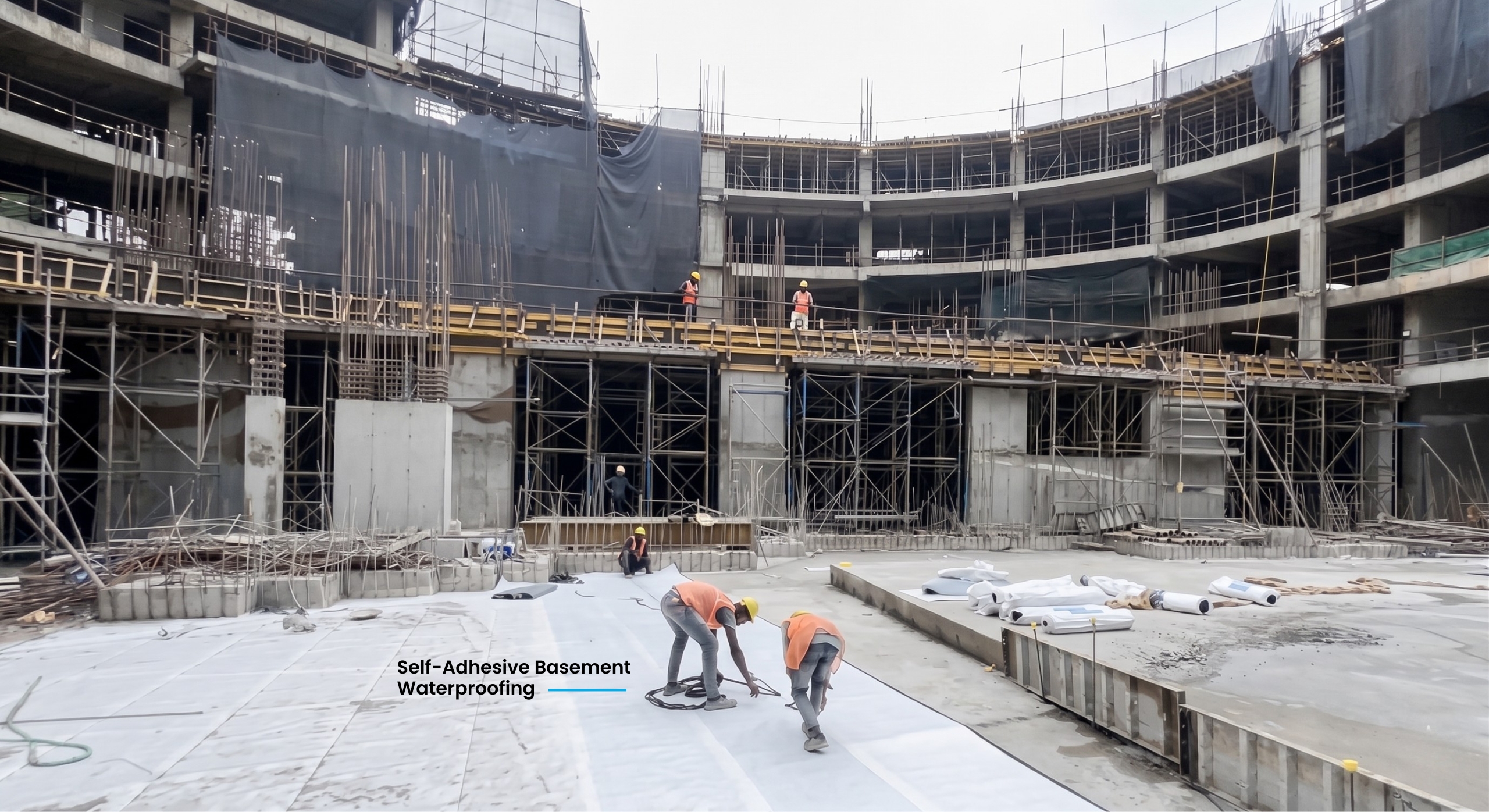
Basements deal with conditions the rest of a structure does not. Constant soil pressure, year-round moisture in the surrounding ground, and hydrostatic forces pushing against walls and slabs with no seasonal break.
In India, monsoon cycles and fluctuating groundwater levels put continuous stress on below-grade systems. When they fall short, it shows fast: seepage through walls, damp floors, salt deposits, and rebar corrosion that eventually compromises the structure itself.
The time to get the basement waterproofing solution right is before the site is backfilled. After that, fixing mistakes is expensive and limited in what it can actually achieve.

Where Is the Moisture Coming From?
Basement moisture may not have single source, and that is part of what makes it hard to address after the fact.
- Hydrostatic pressure forces water through slabs and retaining walls
- Capillary action draws moisture upward through porous concrete
- Surface water enters through cracks, construction joints, and service penetrations
These pathways often operate simultaneously, which is why solutions that address only one or two tend to fail. A complete basement waterproofing solution must account for all three with a continuous barrier that resists pressure, blocks capillary movement, and holds integrity across all transitions and joints.
Our blog on Basement Waterproofing for Commercial Spaces covers what this means for commercial applications.
Sunanda Global’s Basement Waterproofing Solutions
SUNPRUFE is an HDPE-based pre-applied membrane for horizontal applications. Installed before concrete is poured, the two bond into a continuous integral layer once concrete is placed, eliminating the gap where water can track laterally behind the membrane. This lateral tracking is one of the most common and difficult-to-diagnose failure modes in below-grade waterproofing.
The HDPE layer resists tensile stress, construction puncture risk, and chemical aggression from ground salts, sulfates, and soil gases. No priming is required on a properly prepared substrate, and reinforcement work can begin immediately after installation. Suited to raft slabs, tunnel bases, podiums, and underground service rooms.
SUNPRUFE SBS is a post-applied membrane based on SBS-modified bitumen laminated onto a cross-laminated HDPE film. The SBS modification gives it higher flexibility and elongation than standard bitumen membranes, making it the right call for vertical surfaces where the substrate is already cured, and the membrane needs to conform to surface variation. Bonds to both horizontal and vertical cured concrete, perform in cold conditions where standard membranes lose flexibility, and waterproof the substrate instantly with no curing wait. Used on basement walls, retaining walls, and pile head treatments.
Horizontal or Vertical: Picking the Right One
SUNPRUFE: Horizontal, pre-applied before concrete is poured. Its bond with wet concrete is what makes it effective in this configuration.
SUNPRUFE SBS: Vertical, post-applied onto cured concrete. Its flexibility and conformability make it suited to walls and complex geometry.
Using the right product in each position maintains continuity across the full waterproofing envelope.
Getting the Overlaps Right
Most below-grade membrane failures are installation failures at overlaps and transitions, not product failures.
For SUNPRUFE
- Selvedge edge overlaps: minimum 75mm, firmly rolled
- Cut edges and roll ends: sealed with double-sided tape
- Pile head treatments: bitumen primer plus additional SBS membrane layers around the full circumference
For SUNPRUFE SBS
- Side overlaps: minimum 50mm
- End overlaps: minimum 100mm
- Every lap rolled firmly to fully activate the adhesive
Partner with Sunanda Global
Basement waterproofing failures after construction are consistently more expensive to fix than getting the right basement waterproofing solution specified in the first place. External remediation after backfilling requires excavation. Internal remediation manages symptoms rather than eliminating the source.
The cost of rectification almost always exceeds the cost of doing it right during construction. That gap widens the longer the issue goes unaddressed.
With over 45 years of experience in Indian construction, Sunanda Global has built a strong foundation in delivering reliable basement waterproofing solutions across residential, commercial, and infrastructure projects. Our approach combines technical expertise with on-ground execution support to ensure systems perform as intended.
If you are planning your next project, it is worth addressing basement waterproofing solutions at the specification stage. Reach out to Sunanda Global’s technical team.
Frequently Asked Questions
Q.1. Which basement waterproofing solution works best under high hydrostatic pressure?
Sheet membranes. Both SUNPRUFE and SUNPRUFE SBS provide consistent thickness and a continuous barrier that coating-based systems cannot reliably match.
Q.2. Can self-adhesive membranes be used on both floors and walls?
Yes, but with different products. SUNPRUFE for horizontal pre-applied use. SUNPRUFE SBS for vertical post-applied use on cured concrete.
Q.3. Do self-adhesive membranes need a primer?
SUNPRUFE does not, on a properly prepared PCC substrate. SUNPRUFE SBS on vertical surfaces needs a compatible primer dried for 4 to 6 hours before installation.
Q.4. When should the basement waterproofing solution to retaining walls be applied?
During construction, before backfilling. Once the structure is backfilled and occupied, remediation options are limited and costly.