

A leaking roof is almost never a surprise. Damp patches near parapet joints, discolouration around drainage points, paint debonding on the ceiling below. These show months before the damage becomes impossible to ignore.
By then, you are looking at concrete repairs, rebar treatment, and waterproofing costs that far exceed what a correctly specified system would have cost at the outset.
Polyurethane (PU) coatings have become the preferred roof waterproofing system across commercial and industrial projects in India because they form a seamless, elastomeric membrane that accommodates structural movement, resists UV degradation, and outlasts most alternatives under Indian climate conditions.

What is PU-Based Roof Waterproofing?
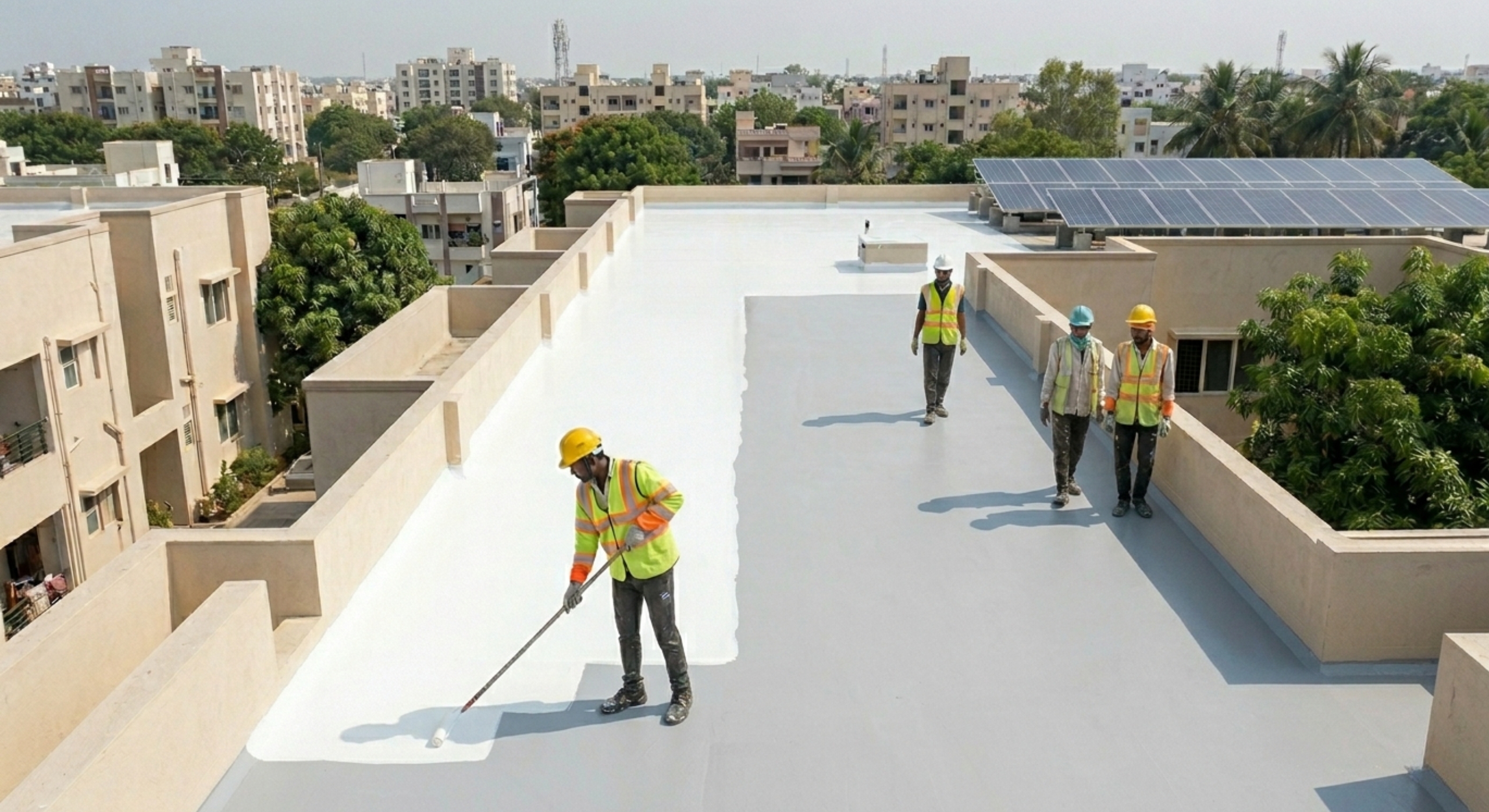
Polyurethane waterproof coating is a liquid-applied system brushed, rolled, or sprayed onto prepared concrete or masonry. On contact with atmospheric moisture, it undergoes a chemical curing reaction and forms a continuous elastomeric membrane, fully bonded to the substrate, with high elongation and flexibility across a wide temperature range.
Why Liquid-Applied PU Coating Is Preferred Over Sheet Membranes
Every sheet membrane has joints. At every lap, parapet termination, and pipe penetration through the slab, there is a seam. Sheet systems depend entirely on the quality of detailing at each of those locations.
A liquid-applied polyurethane waterproof coating eliminates that problem. It cures into a single, unbroken membrane across the full roof surface, covering all penetrations and junctions. Roof slabs across India are also subject to significant thermal movement. Rigid coatings crack under that movement. PU coatings move with the substrate.
Key Performance Properties of Polyurethane Waterproofing Coatings
PU coatings are not specified simply because they are waterproof. They are specified because of a combination of properties other systems cannot consistently deliver together.
- Flexibility and crack bridging: PU membranes maintain continuity over hairline cracks and accommodate structural movement. On existing RCC roofs where micro-cracking is already present, this is a baseline requirement.
- Substrate adhesion: Applied over a correctly primed surface, PU bonds to concrete, masonry, and metal. That bond prevents the membrane from lifting when water pressure builds beneath it.
- UV stability: Aliphatic PU resists photodegradation under prolonged sun exposure without chalking. Aromatic formulations are not UV-stable and must be limited to protected or semi-exposed applications.
- Chemical resistance: PU membranes resist airborne pollutants, cleaning agents, and biological growth without degradation.
Where Polyurethane Waterproofing Coatings Are Used
Flat and sloping RCC roofs on commercial, institutional, and industrial buildings
- Parapet walls and junctions
- Chajjas and external overhangs
- Podium and service decks
- Wet areas requiring crack bridging
For high-traffic terraces with pedestrian load and outdoor use, our blog on Polyurethane Coatings: Best Waterproofing Chemical for Terraces covers those specific requirements.
What to Consider Before Selecting a Polyurethane Waterproof Coating
- Substrate condition: New concrete must be fully cured and dry. Substrate requires crack treatment, cleaning, and repair with polymer-modified mortar where required.
- Exposure category: Direct sun requires a UV-stable aliphatic product. Confined or interior areas need a non-odorous, breathable formulation.
- Single vs. two-component: Single-component PU eliminates mixing errors on site, a real advantage where application conditions are not tightly supervised.
- Finish course compatibility: Confirm compatibility between the PU membrane and the proposed tiles, screed, or topcoat before specifying the full system.
Sunanda Global’s Polyurethane Waterproofing Coatings
SUNPRUFE PU1K is a single-component PU membrane for roof slabs, wet areas, and surfaces where crack bridging is a primary requirement. Applied by brush, roller, squeegee, or spray, it cures into a seamless flexible film without reinforcement layers. Single-component formulation reduces mixing errors and maintains consistency across varying site conditions.
ELASTOROOF PU is a single-component, moisture-cured polyurethane elastomeric membrane for waterproofing a wide range of surfaces indoors and outdoors. It cures to a seamless, rubber-like film with 700% elongation and strong chemical resistance, applied cold without any blending required. Applied in two coats over a SUNPRIME PU primer at a total rate of 1.5 kg/m², with the second coat applied at right angles to the first to ensure uniform coverage. Conforms to European Code DIN 1048 and American Code ASTM C 386.
SUNROOF PU is formulated for exposed applications where UV performance is a design requirement. It covers RCC roofs, chajjas, parapet walls, and external walls on both flat and sloping configurations, new and existing. Can be applied on damp, visibly dry surfaces without blistering. Non-odorous, non-toxic, and breathable.
For a broader understanding of how polyurethane waterproofing performs as compared to traditional methods, our blog on Polyurethane Waterproofing: A Durable and Long-Lasting Solution can be a helpful read.
Partner with Sunanda Global
A correctly applied polyurethane waterproof coating on a well-prepared substrate should hold for ten to fifteen years with periodic inspection and minor maintenance at terminations and penetration details.
Cheaper systems reduce upfront cost but typically cycle through patchwork and replacement much sooner. PU shifts that pattern. Fewer interventions, lower total cost over the building’s service life.
With over 45 years of experience in construction chemical coatings and ISO 9001:2015 accreditation for Research and Development, Sunanda Global’s low-VOC systems deliver performance under the actual conditions of Indian construction. From technical guidance to vetted application partners, the support extends beyond product supply.
If you are choosing a PU coating and want to confirm the right product for your substrate and exposure conditions, Sunanda Global’s technical team can assist.
Frequently Asked Questions
Q1. What is the difference between aliphatic and aromatic PU coatings?
Aliphatic PU is a UV-stable, suited to exposed roofs. Aromatic PU degrades under UV and should only be used in protected or semi-exposed conditions.
Q2. Can polyurethane waterproof coating be applied on an existing roof?
Yes, with proper preparation. Remove existing bitumen-based coatings, treat cracks, and repair damaged areas with polymer-modified mortar before application.
Q3. Does PU coating need a primer?
Yes. A compatible adhesion promoter must be applied first on a completely dry surface. Skipping primer is one of the most common causes of early adhesion failure.
Q4. How many coats are required?
Typically, two coats with a 12–24-hour interval between them, plus a primer and a protective finish course.