

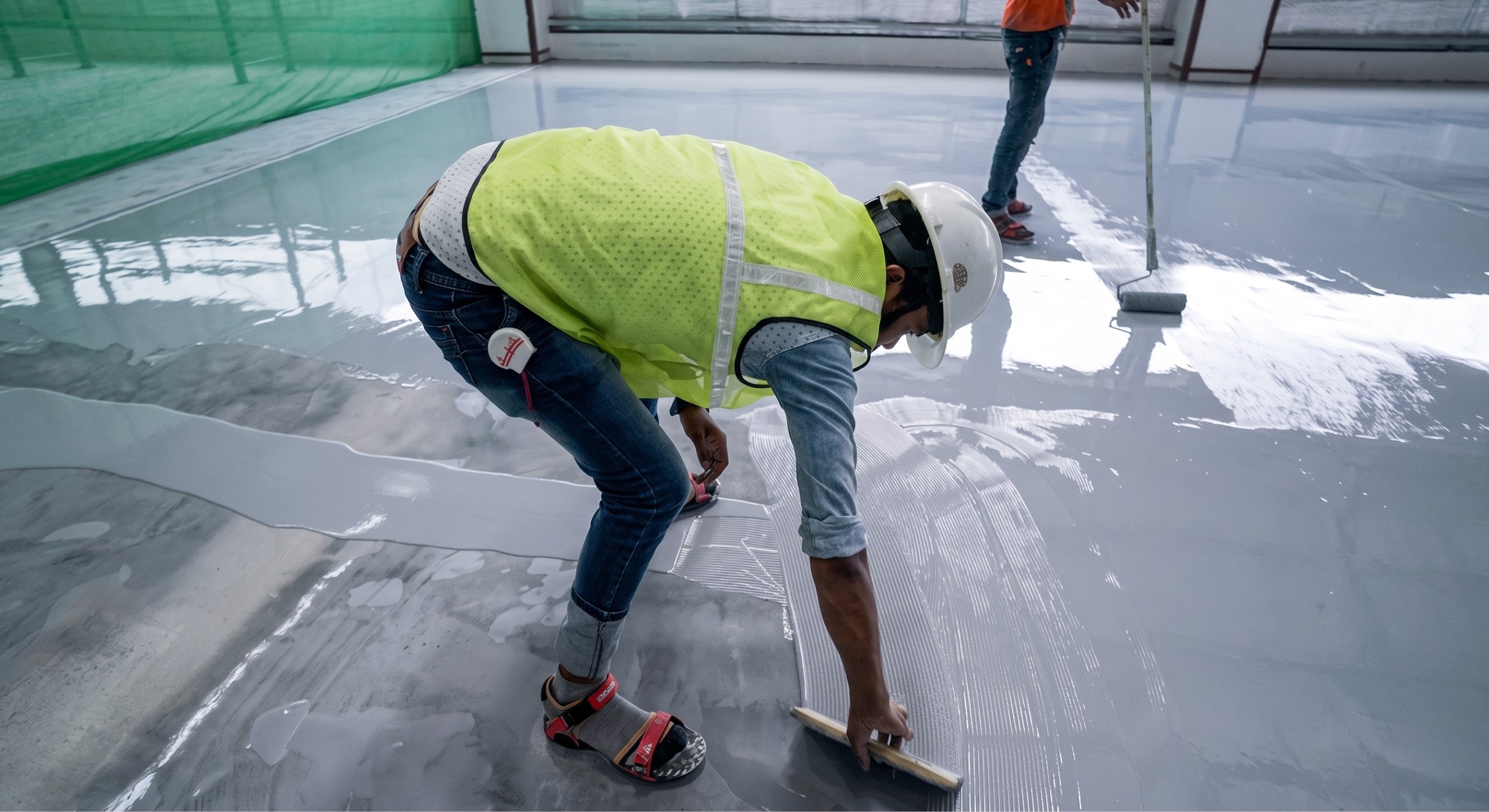
Industrial floors deal with what most building elements never see. Chemical spills, heavy machinery, forklift traffic, and thermal cycling all act on the same surface simultaneously. In environments where hazardous substances are part of daily operations, including manufacturing plants, laboratories, food processing facilities, and chemical storage areas, the floor functions as a containment layer.
Bare concrete does not hold up in these conditions. It is porous, absorbs chemical spills, and degrades from within. Once the surface is compromised, spills reach the substrate, accelerate deterioration, and create safety hazards that are expensive to reverse.

Why Conventional Floors Fail Under Chemical Exposure
Concrete is alkaline by nature. Acid spills neutralize the surface, causing the cement matrix to break down. Solvent exposure attacks the binder. Repeated wet-dry cycles from chemical washdowns open pores and create pathways for deeper infiltration.
The result is surface scaling, joint deterioration, cracking, and in sustained exposure conditions, structural damage to the slab itself. By the time visible damage appears, the problem has already extended well below the surface. For a full picture of how epoxy flooring systems address these failure modes, our blog on “The Ultimate Guide to Epoxy Flooring” covers the fundamentals in detail.
Why Epoxy Flooring Is the Right System
Epoxy flooring solutions work because of how they cure. When epoxy resin and hardener react, they form a cross-linked polymer network that is non-porous, chemically inert to a wide range of substances, and fully bonded to the substrate. That bond means there are no joints, no seams, and no gaps for spills to find their way through.
The result is a seamless, impermeable barrier that resists acids, alkalis, oils, and solvents while remaining structurally stable under heavy load and abrasion. It can also be formulated with slip-resistant or anti-static properties depending on the facility requirement.
Common concerns about epoxy flooring, including questions about long-term performance, compatibility with existing substrates, and maintenance demands, are addressed in our blog Top 5 Myths About Self-Levelling Epoxy Flooring Debunked. Working with qualified epoxy flooring contractors ensures the system is applied correctly and performs to specification.
The Role of Flooring System Layers
A correctly specified epoxy flooring system is not a single coat. It is a layered system where each layer has a defined function.
The underlay levels the substrate, fills surface voids and irregularities, and provides the adhesion base for the topcoat. Without this, the topcoat performs inconsistently and is vulnerable to delamination under point loads.
The topcoat is where chemical resistance, abrasion performance, and surface finish are delivered. The formulation of the topcoat determines what chemical exposure the system can handle and at what concentration and duration.
Both layers working together is what gives the system its long-term performance. Topcoat alone on an unprepared substrate will not deliver what the product datasheet specifies.
Sunanda Global’s Epoxy Flooring Solutions
SUNEPOXY SL UNDERLAY is a self-leveling epoxy-based monolithic underlay with a flowable consistency that provides excellent adhesion to concrete and metal substrates. Non-shrink and solvent-free, it delivers superior abrasion resistance and chemical resistance as a base for the full flooring system. Nuclear grade rated.
SUNEPOXY SL TOPCOAT is a flow-applied epoxy resin monolithic floor topping that produces a dense, impervious, seamless surface. It offers excellent resistance to a wide range of chemicals, strong abrasion resistance, and a self-leveling glossy finish available in multiple colors. Hygienic surface finish. Nuclear grade rated. Used as the primary chemical-resistant finish layer in industrial and commercial facilities.
SUNEPOXY AS is an anti-static, conductive, self-leveling epoxy flooring system for environments where electrostatic discharge control is a requirement. Solvent-free with low VOC, it provides excellent abrasion and chemical resistance, antimicrobial properties, low odor, and a pore-free surface suited to cleanrooms and sterile manufacturing environments.
SUNEPOXY EI is a high-build epoxy insulation coating with high dielectric strength and breakdown voltage of 34 to 37 KV at 1000 to 1200 microns DFT. It provides excellent chemical resistance and is used where electrical insulation is a primary floor performance requirement alongside chemical protection.
Application Areas
Epoxy flooring solutions from Sunanda Global are suited to
- Chemical and pharmaceutical manufacturing facilities
- Food and beverage processing plants
- Laboratories and cleanrooms
- Industrial warehouses and loading bays
- Power generation and electrical switch rooms
- Automotive workshops and service bays
For a detailed breakdown of performance benefits across these environments for epoxy flooring contractors, our blog on Top 7 Benefits of Epoxy Flooring for Commercial Spaces is an insightful read.
Partner with Sunanda Global
With over 45 years of experience in Indian construction, Sunanda Global has built a strong foundation in delivering reliable epoxy flooring solutions across residential, commercial, and infrastructure projects. Our approach combines technical expertise with on-ground execution support to ensure systems perform as intended.
Sunanda Global supports projects across major cities including Bangalore, Chennai, Hyderabad, Mumbai, and Delhi. From system selection to detailing and application guidance, our team works closely with stakeholders to ensure long-term performance.
If you are planning your next project, reach out to Sunanda Global’s technical team to get it right from the start.
Frequently Asked Questions
Q.1. What makes epoxy flooring suitable for chemical spill-prone environments?
Epoxy cures into a cross-linked, non-porous polymer network that is chemically inert to acids, alkalis, solvents, and oils. The seamless surface has no joints or gaps for spills to penetrate.
Q.2. What is the difference between SUNEPOXY SL UNDERLAY and SUNEPOXY SL TOPCOAT?
The underlay levels the substrate and provides the adhesion base. The topcoat delivers chemical resistance, abrasion performance, and the finished surface. Both are required for a fully performing system.
Q.3. Where is SUNEPOXY AS used?
In environments where electrostatic discharge is a risk, including electronics manufacturing, cleanrooms, and pharmaceutical facilities where static buildup can damage equipment or create ignition risk.