

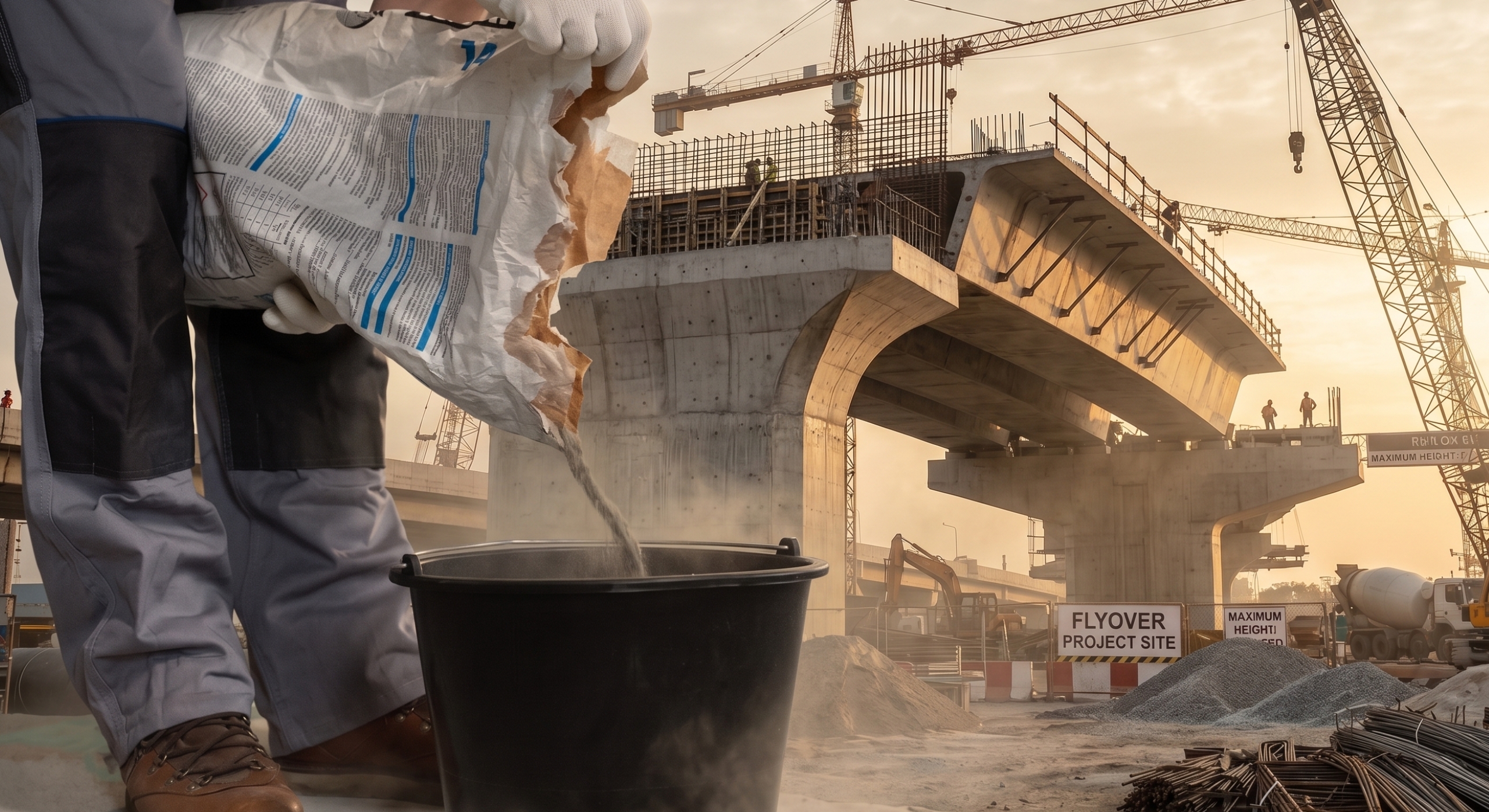
Concrete and steel form the skeleton of a building. Construction chemicals determine how long that skeleton holds up.
From waterproofing membranes on a terrace to epoxy flooring in a pharmaceutical facility, construction chemicals in India cover a wide range of performance requirements across the construction lifecycle. The first step in specifying the right system is understanding what each type of construction chemical does.

Waterproofing Systems
Waterproofing is the largest category among construction chemicals in India. Roofs, basements, terraces, bathrooms, and external walls face different moisture conditions and need different systems.
- Waterproofing coatings such as PU waterproofing and acrylic-based systems are liquid-applied to prepared surfaces, forming a continuous crack-bridging membrane for roof waterproofing, terrace waterproofing, and wall waterproofing applications.
- Liquid-applied joint-free waterproofing membranes including polyurethane systems cure into seamless elastomeric films. The preferred waterproof roof coating for flat RCC roofs and podium decks in commercial and infrastructure projects.
- Self-adhesive waterproofing membranes such as HDPE and SBS-based systems are pressure-bonded without heat. Used for basement waterproofing solutions, tunnels, and below-grade structures where membrane continuity under hydrostatic pressure is critical.
- Waterproofing admixtures are dosed into concrete during mixing to reduce permeability at the matrix level. Used in water-retaining structures, foundations, and roof slabs.
- Spray-applied polyurethane foam insulation provides simultaneous thermal insulation and waterproofing on roof surfaces in a single application.
Protective Coatings and Corrosion Protection
Structural concrete and steel in India face accelerated deterioration from carbonation, chloride ingress, and industrial pollutants. Protective systems extend service life by forming a barrier between the substrate and its environment.
- Exterior coatings and paints including anti-carbonation coatings slow CO2 ingress into concrete, protecting reinforcement from the pH drop that initiates corrosion. Standard specification on external facades, bridges, and coastal structures.
- Corrosion protection systems are applied to reinforcement bars or structural steel. In coastal and industrial environments, corrosion is one of the primary causes of premature structural failure.
- Epoxy primers prepare steel and concrete for subsequent protective or decorative systems, ensuring adhesion and preventing undercutting corrosion.
- Polyurethane coatings and epoxy coatings provide chemical resistance, UV stability, and abrasion resistance on external and industrial surfaces. Aliphatic PU coatings are the standard specification where UV exposure is a design condition.
- Intumescent paints are passive fire protection coatings for structural steel. On exposure to heat, they expand into an insulating char layer that delays the steel reaching its critical temperature, required in commercial, industrial, and public buildings.
Flooring Systems
Industrial and commercial flooring must handle chemical exposure, heavy loads, thermal cycling, and abrasion that standard concrete cannot sustain without a surface system.
- Epoxy flooring solutions including self-levelling epoxy coatings and high-build epoxy systems are used in pharmaceutical facilities, food processing plants, warehouses, and car parks. Epoxy resin systems provide chemical resistance and a seamless, easily cleaned surface.
- Polyurethane concrete flooring handles thermal shock and heavy dynamic loads better than epoxy. It is the preferred industrial flooring solution in food and beverage facilities, cold storage, and transport hubs.
- Floor hardeners and densifiers are applied to fresh or existing concrete to reduce dusting, increase surface hardness, and extend the service life of industrial concrete floors without a full coating system.
Concrete Enhancement Materials
- Concrete admixtures are dosed at the batching plant to modify workability, set time, strength, and durability. Superplasticizers, accelerators, retarders, and waterproofing admixtures are among the most widely used construction chemicals in India across all project types.
- Concrete repair materials and bonding agents restore deteriorated concrete to structural performance. Bonding agents for plaster, concrete, gypsum, and AAC or CC blocks ensure adhesion between old and new materials.
- Grouts are used for precision filling of machine bases, column bases, and anchor bolts where shrinkage-free, high-strength placement is required.
- Curing aids retain moisture in freshly placed concrete during hydration, reducing surface cracking and improving strength, particularly in hot and dry site conditions.
Tile Installation Systems
Tile adhesives and tile grouts have largely replaced traditional sand-cement bedding in commercial and residential construction. Polymer-modified tile adhesives provide stronger bond strength, flexibility, and resistance to moisture, reducing hollow sounds and long-term debonding.
Partner with Sunanda Global
With over 45 years of experience, Sunanda Global works across the full range of construction chemicals in India, including waterproofing systems, coatings, flooring, and concrete modification materials. This allows system compatibility to be addressed at the specification stage, rather than resolved during execution.
We invest 5% of annual revenue in R&D, with 60% focused on LEED-compliant and eco-friendly products. All systems are developed and supplied under ISO 9001:2015-certified processes.
As a construction chemical manufacturer in India, Sunanda Global provides low-VOC waterproofing and protection systems designed for Indian site conditions, including high moisture exposure, temperature variation, and aggressive environments.
For technical support, product selection, substrate requirements, and detailing, get in touch with the Sunanda Global team.
Frequently Asked Questions
Q.1. What are the primary categories of construction chemicals in India?
Waterproofing systems, protective coatings, flooring systems, concrete admixtures and repair materials, and tile installation systems.
Q.2. How is the right construction chemical selected?
Based on substrate type, exposure conditions, load requirements, and construction stage. Product compatibility within the system is critical.
Q.3. Why do construction chemical systems fail?
Incorrect product selection, poor substrate preparation, or incompatibility between system components. Failures are typically at interfaces, not within the material itself.
Q.4. Are low-VOC systems necessary for all projects?
As a leading construction chemical manufacturer in India, we prefer them in enclosed or occupied environments and where environmental compliance is a requirement. Performance should still be evaluated against exposure conditions.