

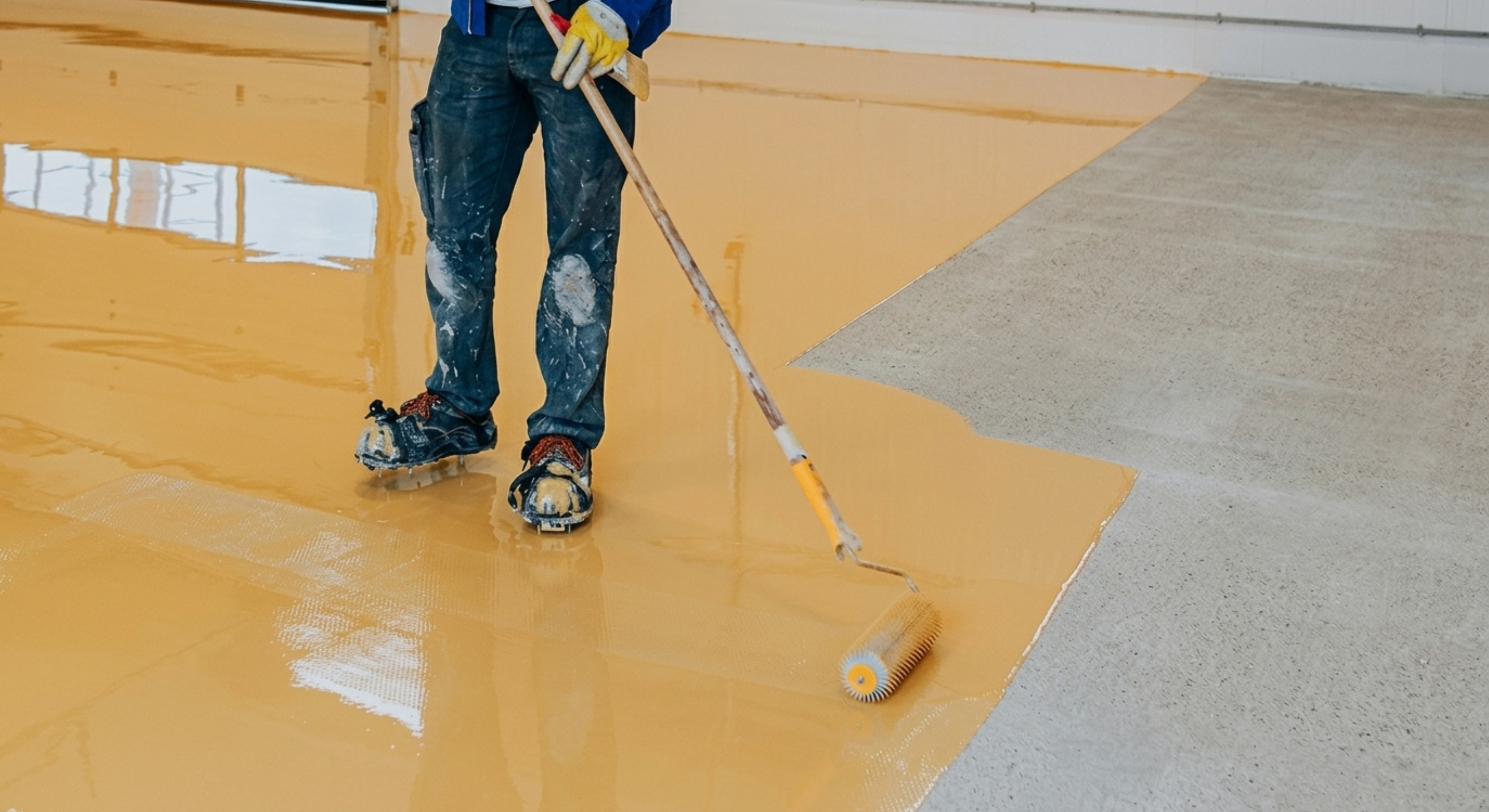
Concrete is built for long service, but its exposure conditions matter. Industrial chemicals, moisture, chlorides, abrasion, and temperature variations can gradually affect the surface and, in aggressive environments, contribute to deterioration.
This is where epoxy coatings are useful. Applied over prepared concrete, the cured coating creates a dense barrier between the surface and its operating environment. Epoxy is also known for strong adhesion and resistance to abrasion and a range of chemicals, which explains its widespread use on concrete in industrial and infrastructure projects.

How Epoxy Coatings Work on Concrete
An epoxy coating is formed by the chemical reaction between an epoxide resin and a polyamine hardener. After curing, it forms a hard, adherent layer over the concrete.
The coating restricts contact between the concrete surface and water, chemicals, oils, and other contaminants. Formulation plays an important role here. An epoxy intended for chemical exposure, for instance, has different performance requirements from one specified primarily for abrasion resistance.
The concrete itself also needs attention before application. A coating applied over a poorly prepared, contaminated, or unsound surface will not deliver the same adhesion as one applied over properly prepared concrete.
Protecting Concrete in Aggressive Environments
Moisture and Chloride Exposure
Chlorides are a particular concern in coastal, marine, and other chloride-rich environments. They can penetrate concrete and eventually reach the embedded steel reinforcement. At sufficient concentrations, chlorides can disrupt passive protection around the steel and initiate corrosion.
As corrosion progresses, the resulting rust occupies more volume and creates pressure within the surrounding concrete. Cracking, delamination, and spalling can follow.
Coating the concrete surface with epoxy adds another line of protection by restricting the entry of water and chlorides through that surface. It does not take the place of adequate concrete cover, good concrete quality, or correct structural detailing. Those remain fundamental to durability.
Chemical Exposure
Industrial concrete has a different set of demands. Floors and other surfaces may regularly encounter oils, process liquids, cleaning chemicals, or other aggressive substances.
Epoxy is commonly considered for these areas because suitable formulations have good chemical resistance. Before specifying a coating, the actual exposure needs to be understood:
What chemical will contact the surface?
- At what concentration?
- Will exposure be occasional or continuous?
- What temperatures are involved?
- What is the present condition of the concrete?
These details matter because chemical resistance is specific to the epoxy formulation and the service conditions.
Key Benefits of Epoxy Coatings for Concrete
A properly specified epoxy system can add several useful properties to a concrete surface:
- Abrasion resistance: Useful where traffic, equipment, or regular movement causes surface wear.
- Chemical resistance: Protects against specified chemicals, oils, and industrial contaminants.
- Reduced moisture ingress: The coating limits direct contact between the concrete surface and water.
- Adhesion to concrete: Epoxy systems can develop strong adhesion when the substrate has been correctly prepared.
- Long-term surface protection: Reduced exposure and wear can help lower the need for frequent surface repairs.
No single epoxy formulation provides the same level of performance in every environment. Product selection must follow the actual exposure and use of the concrete.
Where Are Epoxy Coatings Used?
The combination of adhesion, abrasion resistance, and chemical resistance gives epoxy coatings a broad range of concrete applications. These include:
- Industrial and manufacturing floors
- Warehouses
- Parking structures
- Concrete exposed to oils or chemicals
- Production and processing areas
- Selected infrastructure and utility structures
Traffic, chemical contact, moisture, temperature, and the condition of the existing concrete all influence the coating specification.
Sunanda Global’s Epoxy Coating Solutions
Sunanda Global develops construction chemical systems for the protection, repair, and maintenance of concrete. Its range includes epoxy-based solutions for applications where concrete requires additional surface protection.
Choosing an epoxy system starts with the project conditions rather than coating alone. The condition of the concrete expected chemical or mechanical exposure, application environment, and required finish all need to be reviewed before a system is specified.
Surface preparation is important. Even a suitable epoxy formulation relies on a properly prepared substrate to develop the required bond and perform as intended.
For project-specific epoxy coating requirements, contact Sunanda Global for product selection and technical guidance.
Conclusion
Epoxy coatings give concrete an additional layer of protection where exposure is difficult to avoid. Moisture, chemicals, abrasion, and contaminants are kept away from direct contact with the coated surface, while the epoxy provides a durable, adherent finish.
Long service life, however, comes from the complete specification: suitable concrete, appropriate surface preparation, the right epoxy formulation, correct application, and maintenance suited to the operating environment.
FAQs
Q.1 What is an epoxy protective coating for concrete?
It is a resin-and-hardener system that cures over prepared concrete to form a hard, adherent barrier against moisture, chemicals, contaminants, and surface wear.
Q.2. How do epoxy coatings protect concrete?
The cured epoxy forms a dense layer over concrete, restricting direct contact with water, chemicals, oils, and other substances that can affect the surface.
Q.3. Are epoxy coatings resistant to chemicals?
Yes, depending on the formulation. Chemical type, concentration, contact time, and temperature need to be checked before an epoxy coating is specified.
Q.4. Can epoxy coatings reduce chloride ingress into concrete?
A properly applied epoxy coating can restrict water and chloride ingress through the coated concrete surface, adding another layer of protection in chloride-exposed environments.
Q.5. Where are epoxy coatings commonly used on concrete?
Typical applications include industrial floors, warehouses, parking structures, production facilities, and concrete surfaces exposed to abrasion, oils, chemicals, or other demanding conditions.