

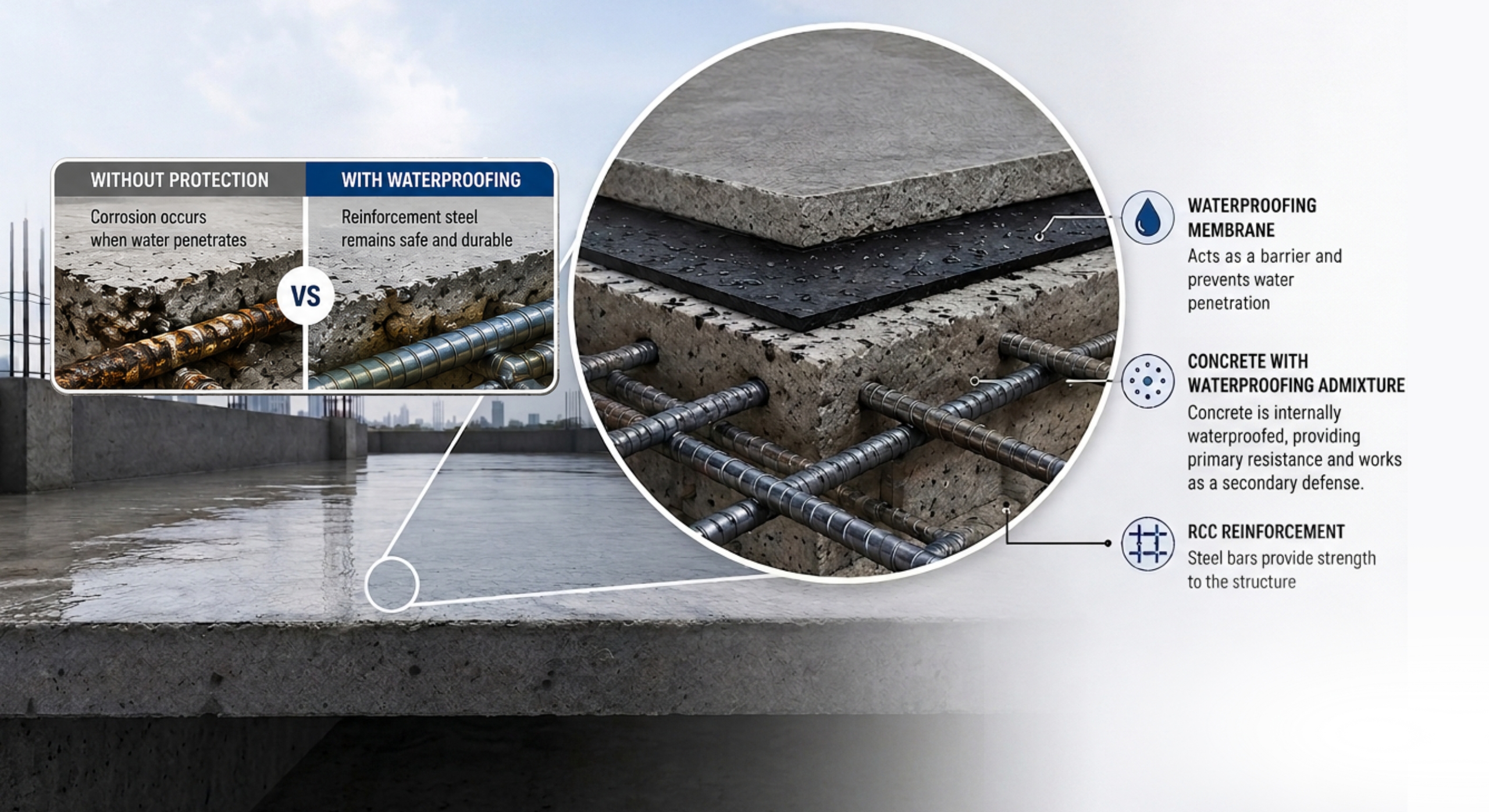
Reinforced concrete structures depend on two materials working together. Concrete handles compressive loads. Steel reinforcement handles tension. That combination gives RCC its structural capability. But steel inside concrete is vulnerable. When water, chlorides, and carbon dioxide penetrate the concrete cover, they break down the natural protection concrete provides to the rebar. Waterproofing is what slows that process down and extends the service life of the structure.

How Concrete Normally Protects Steel
Fresh concrete has a highly alkaline pore environment, typically between pH 12.5 and 13.5. At that alkalinity, a thin passive oxide film forms on the steel surface and keeps corrosion rates very low. The concrete cover surrounding the rebar acts as a physical diffusion barrier between the environment and the steel. As long as the cover stays dense, well compacted, and crack-free, aggressive agents reach the steel slowly.
What Breaks That Protection Down?
Two processes destroy the passive film on rebar.
Carbonation occurs when carbon dioxide from air diffuses into concrete, reacts with calcium hydroxide, and lowers the pH. As pH drops, the passive film on the steel becomes unstable.
Chloride ingress occurs when salts from marine exposure, contaminated water, de-icing chemicals, or industrial environments migrate through concrete pores and cracks and reach the rebar. Once enough chlorides accumulate at the steel surface, the passive film breaks down locally and pitting corrosion begins, even when the concrete surface looks intact.
Once corrosion starts, rust products form and occupy significantly more volume than the original steel. That expansion generates internal pressure in the concrete, producing microcracks, delamination of the cover, rust staining, and eventually spalling.
How Waterproofing Helps
Waterproofing reduces the permeability and absorbency of the concrete system. With less moisture entering the concrete, the transport of dissolved chlorides and carbon dioxide slows significantly. Steel corrosion requires water, oxygen, and corrosive ions to coexist. Interrupting moisture movement makes it far harder for that electrochemical reaction to sustain itself.
A good waterproofing system limits three transport mechanisms:
Capillary suction, which pulls water into fine pores
Permeation, which moves dissolved salts through interconnected voids
Crack-based ingress, where water enters through shrinkage cracks, construction joints, and honeycombing
Waterproofing coatings do not protect steel directly the way a zinc coating would. They protect the concrete cover, and the concrete cover is what protects the steel. That distinction matters when specifying a system.
Where Waterproofing Matters Most
In dry indoor environments, rebar corrosion can remain slow for years without special protection. In wet or chemically aggressive environments, that changes completely. Roofs, basements, podium slabs, parking structures, water retaining structures, toilets, sewage works, and coastal or marine structures all involve repeated or sustained moisture exposure. In these conditions, the electrochemical corrosion cycle runs continuously.
Waterproofing solutions are especially critical where hydrostatic pressure exists, chloride exposure is high, cracks are likely, design life requirements are long, or repair access is difficult and expensive.
Types of Waterproofing Solutions for Corrosion Protection
Different systems address corrosion risk in different ways.
Membrane systems create an external physical barrier against water ingress at the concrete surface.
Crystalline systems react within the pore structure and block capillary pathways from within the concrete matrix.
Integral waterproofing admixtures reduce permeability throughout the concrete mix rather than at the surface alone.
Protective waterproofing coatings reduce surface absorption and limit wetting of the concrete face.
Joint sealants and injection systems address the weak points where water typically enters first, including construction joints, tie holes, and honeycombing.
The most effective waterproofing solutions address both bulk permeability and defect-related ingress together. No single product covers every exposure condition. System selection depends on exposure class, crack risk, structural movement, workmanship quality, and long-term maintenance expectations.
Partner with Sunanda Global
Sunanda Global has worked across construction chemicals in India for over 45 years, covering waterproofing, coatings, flooring, and concrete modification. System compatibility gets addressed at the specification stage, not during execution.
5% of annual revenue goes into R&D, with 60% of that directed at LEED-compliant and eco-friendly products. Every system is developed and supplied under ISO 9001:2015 certified processes.
As a construction chemical manufacturer in India, Sunanda Global develops waterproofing solutions and waterproofing coatings built for Indian site conditions including high moisture exposure, chloride-rich environments, and temperature variation.
Contact the Sunanda Global team for product selection, technical support, substrate evaluation, and application detailing.
Frequently Asked Questions
Q1. Does waterproofing stop rebar corrosion completely?
Waterproofing significantly reduces the rate of moisture, chloride, and carbon dioxide ingress into concrete, which slows corrosion considerably. It does not eliminate corrosion risk entirely if the concrete cover is poorly compacted, cracked, or inadequately cured.
Q2. Which structures need waterproofing for corrosion protection most urgently?
Structures in direct contact with water, chlorides, or carbon dioxide-rich environments need it most. Basements, roofs, parking structures, water retaining structures, and coastal or marine works all fall into this category.
Q3. Can a single waterproofing product protect against all corrosion risks?
No single product addresses every exposure condition. Effective corrosion protection typically requires a combination of waterproofing coatings, joint treatment, crack repair, and in aggressive environments, multiple layers of defense working together.