

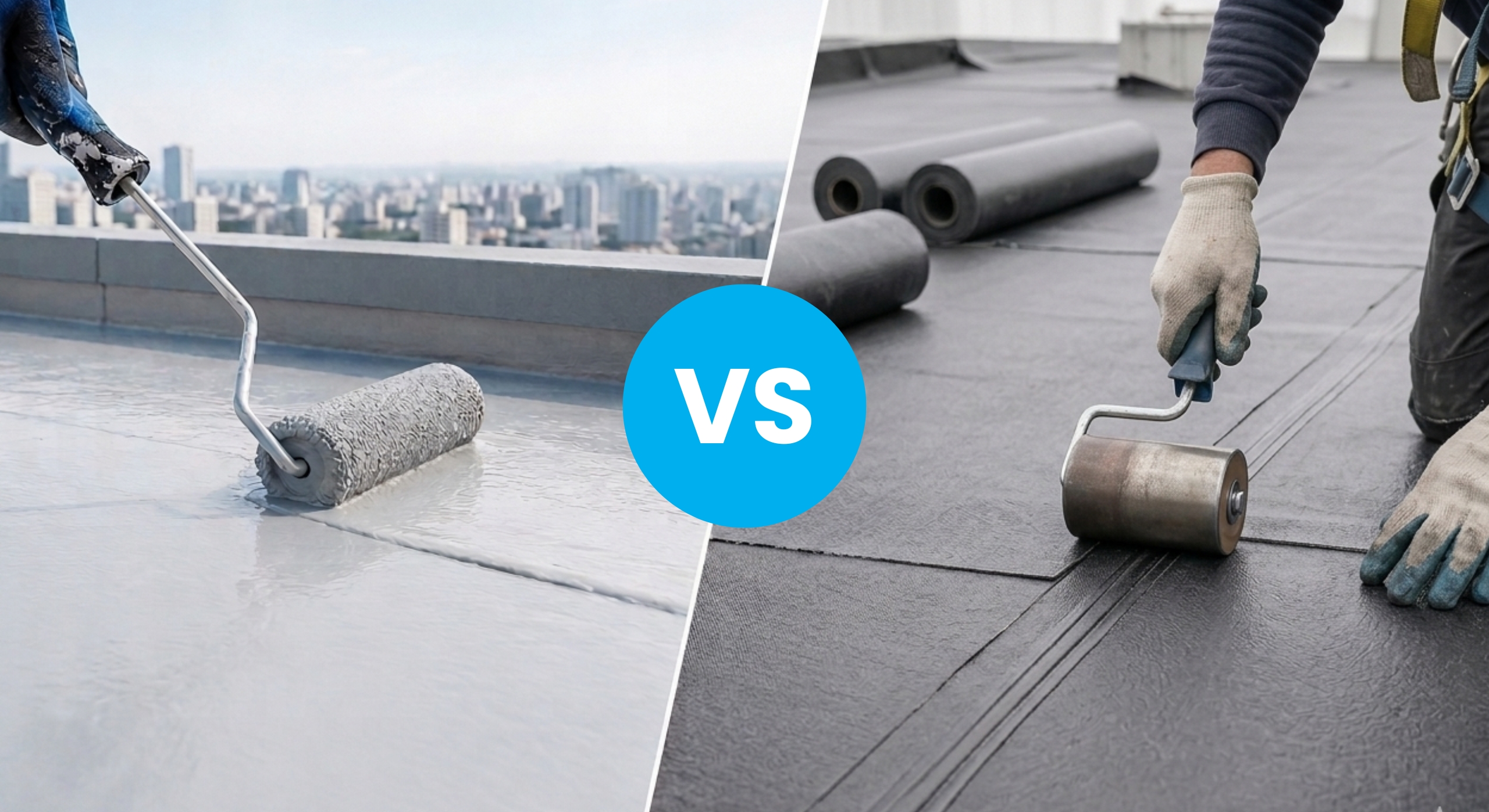
Waterproofing membrane selection directly affects how a structure performs over its service life. The wrong system for a given substrate, exposure condition, or project type leads to leaks, callbacks, and costly remediation. For contractors, understanding when to specify a liquid applied waterproofing membrane and when a waterproofing membrane sheet is the right call is a practical necessity, not a theoretical exercise.

What Is a Liquid Applied Waterproofing Membrane?
A liquid applied waterproofing membrane is applied to the substrate by spray, roller, brush, or squeegee after concrete placement. It cures into a seamless, flexible, monolithic barrier that conforms tightly to the surface, including irregular shapes, corners, and complex detailing around penetrations and drains.
The seamless nature of a liquid applied waterproofing membrane eliminates joints and overlaps, which are the most common points of failure in waterproofing systems. As the structure settles or moves, the membrane stretches with it, maintaining the barrier without cracking. This makes it well suited to surfaces with complex geometry, multiple penetrations, or where structural movement is expected.
Liquid applied membranes work on both vertical and horizontal surfaces and perform well in above-grade and below-grade conditions.
What Is a Sheet Waterproofing Membrane?
A waterproofing membrane sheet is a factory-manufactured roll produced from materials including modified bitumen, PVC, HDPE, or rubber polymers. Because it is manufactured under controlled conditions, it delivers consistent, uniform thickness across the applied area. That factory-controlled thickness is one of its primary advantages over liquid systems, where final thickness depends on applicator skill and site conditions.
A waterproofing membrane sheet requires precise installation. Sheets must be carefully overlapped and sealed at every joint. Poorly sealed laps and joints are where sheet membrane systems fail. When installed correctly, they offer strong puncture resistance, durability under mechanical loads, and reliable performance in high hydrostatic pressure conditions.
Sheet membranes are typically used on flat or uniform surfaces in below-grade walls, tunnels, basement raft slabs, and podium decks where membrane thickness is a critical performance parameter.
Key Differences Contractors Need to Know
Factor |
Liquid-Applied Waterproofing Membrane |
Sheet Waterproofing Membrane |
| Application method | Spray, roller, brush, or squeegee | Rolled out and fixed by torching, adhesive, or heat welding |
| Thickness control | Depends on applicator skill on site | Factory controlled, uniform throughout |
| Surface suitability | Irregular, curved, penetration-heavy surfaces | Flat, open, uniform surfaces |
| Joints and overlaps | Seamless, no joints or overlaps | Requires precise overlap sealing at every joint |
| Flexibility | High elongation, stretches with structural movement | Generally less flexible, can crack or delaminate under movement |
| Skill requirement | Applicable with standard tools, lower skill dependency | Requires experienced installation crews |
| Leak detection | Detailed inspection required to locate failure point | Failures typically occur at laps and joints, easier to locate |
| Best suited for | Complex geometry, penetrations, refurbishment, above and below grade | Large open areas, high hydrostatic pressure, below grade slabs and tunnels |
| Mechanical resistance | Requires protective layer under heavy traffic or load | Stronger puncture and abrasion resistance under mechanical loads |
How to Choose the Right System
Four questions help narrow the selection:
What does the surface look like?
Irregular or curved substrates with multiple penetrations favor a liquid applied waterproofing membrane. Flat, open surfaces suit a waterproofing membrane sheet.
Is structural movement expected?
If the substrate is likely to settle or shift, liquid applied systems offer better long-term flexibility.
What are the installation constraints?
Liquid-applied waterproofing membranes apply faster across complex areas with standard tools. Sheet waterproofing membranes require more precise handling and experienced installation crews.
What are the mechanical load requirements?
Where puncture resistance and durability under load are priorities, sheet membranes generally perform better.
In some projects, both systems are used together. Sheet membranes cover large, open podium and basement areas while liquid applied membranes handle detail-heavy zones and penetrations.
Partner with Sunanda Global
Sunanda Global has worked across construction chemicals in India for over 45 years, covering waterproofing, coatings, flooring, and concrete modification. System compatibility gets addressed at the specification stage, not during execution.
5% of annual revenue goes into R&D, with 60% of that directed at LEED-compliant and eco-friendly products. Every system is developed and supplied under ISO 9001:2015 certified processes.
As a construction chemical manufacturer in India, Sunanda Global supplies liquid applied waterproofing membranes and waterproofing membrane sheet solutions built for Indian site conditions including high moisture exposure, temperature variation, and aggressive environments.
Contact the Sunanda Global team for product selection, technical support, substrate evaluation, and application detailing.
Frequently Asked Questions
Q1. Can a liquid-applied waterproofing membrane be used below grade?
Yes. Liquid-applied waterproofing membranes perform well in both above-grade and below-grade conditions, including foundation walls and basement slabs.
Q2. What causes sheet waterproofing membrane waterproofing to fail?
Most sheet waterproofing membrane failures may occur at laps, joints, and edge details where overlaps are inadequately sealed. Precise installation and correct overlap sealing are critical to system performance.
Q3. Is one system more durable than the other?
Durability depends on the exposure condition and correct installation, not the system type alone. Sheet waterproofing membranes offer strong puncture resistance under mechanical loads. Liquid applied waterproofing membranes provide strong crack bridging and flexibility under structural movement.