

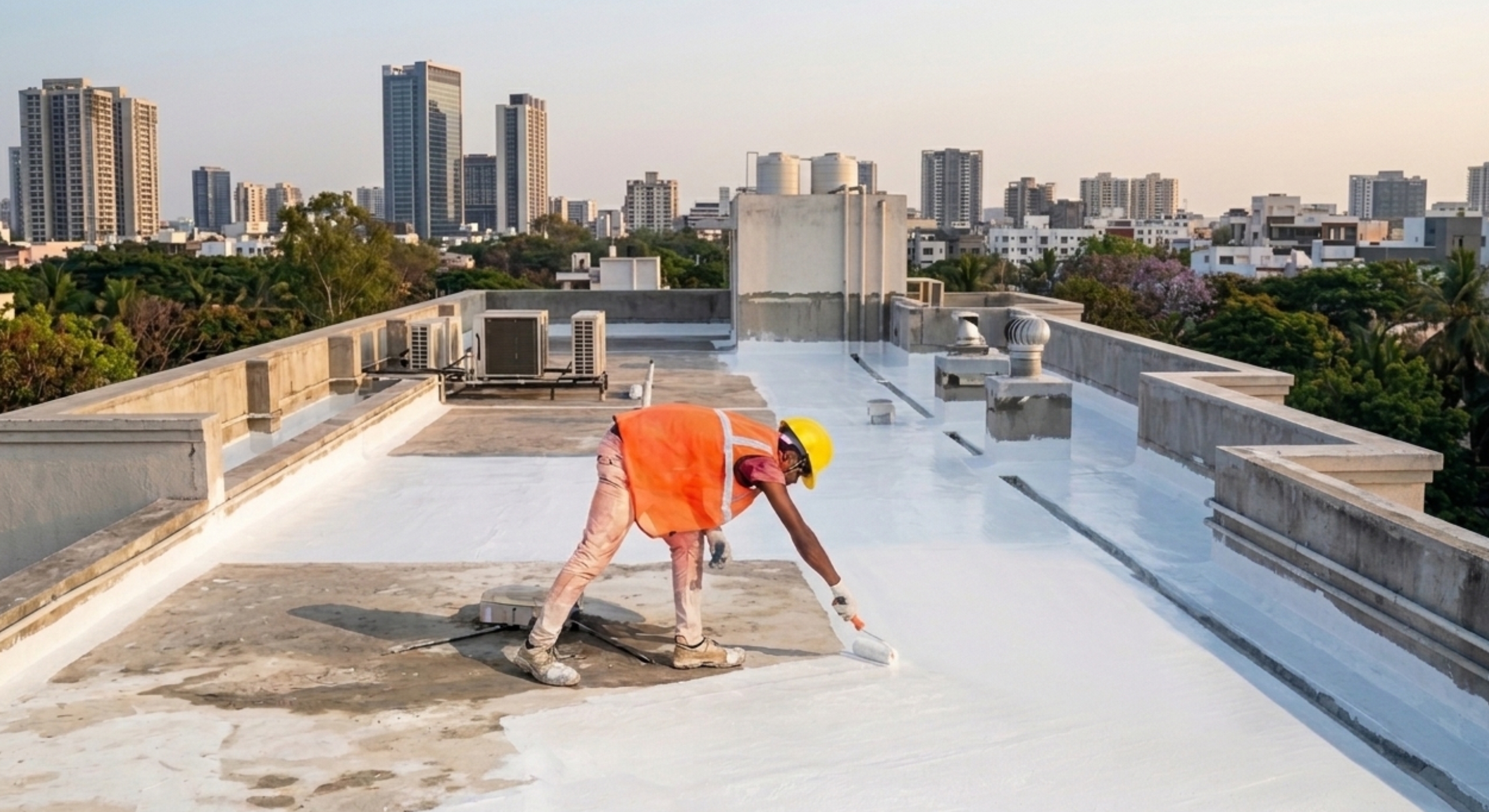
Concrete performs reliably in structural applications, but surface exposure is where most problems begin. Moisture ingress, chemical contact, abrasion from movement, and UV exposure all act directly on the top layer of concrete. Over time, this leads to surface dusting, staining, micro cracking, and gradual loss of density.
Protective coatings are specified to control these conditions. They are not decorative layers in industrial or infrastructure work. They are functional systems that influence durability, maintenance cycles, and long-term performance.
In practice, coating selection depends on exposure conditions, service environment, and performance requirements.

What Are Protective Coatings for Concrete?
Protective coatings are resin based or polymer modified systems applied over hardened concrete to limit direct exposure to external agents. These systems are designed to reduce water absorption, resist chemical attacks, and protect against abrasion and weathering.
A coating system typically includes a primer and one or more build coats. The primer is responsible for penetration and bond strength. The topcoat defines chemical resistance, flexibility, UV stability, and surface performance.
In field conditions, performance is heavily influenced by surface preparation. Even high-grade coatings will fail early if applied over laitance, dust, oil contamination, or weak concrete zones.
Acrylic Waterproofing Coating
An acrylic waterproofing coating is a water based elastomeric system used for exterior concrete protection. It forms a flexible film that helps reduce water ingress while allowing limited substrate movement.
It is commonly specified in architectural and light duty exposure conditions where waterproofing and appearance both matters.
Typical applications include:
- Exterior walls exposed to rain
- Terrace surfaces with moderate exposure
- Balcony slabs
- Decorative concrete finishes
Acrylic systems are generally preferred when UV stability and ease of application are required, especially on vertical or semi-exposed surfaces.
Epoxy Resin Coating
An epoxy resin coating is a two-component system based on resin and hardener chemistry. Once cured, it forms a dense, high strength film that bonds strongly to concrete.
It is widely used in industrial environments where mechanical load and abrasion resistance are primary requirements.
Key characteristics include high adhesion, surface hardness, and a seamless finish that reduces dirt accumulation and improves cleanability.
In environments with chemical exposure, a chemical resistant epoxy coating is specified. These systems are formulated to withstand contact with oils, fuels, solvents, alkalis, and a range of industrial chemicals.
Typical applications include:
- Industrial production floors
- Warehouses and logistics facilities
- Chemical storage and handling zones
- Maintenance and utility areas
Epoxy systems are generally selected for controlled environments where temperature fluctuation is limited.
Polyurethane Waterproof Coating
A polyurethane waterproof coating is used where flexibility and weather resistance are required. Unlike rigid coating systems, polyurethane can accommodate thermal movement without losing adhesion.
It also offers strong UV resistance, which makes it suitable for exposed outdoor conditions.
In practice, waterproofing systems are subjected to repeated expansion and contraction cycles.
Typical applications include:
- Roof slabs and terraces
- Podium decks
- Exterior exposed concrete surfaces
- Parking structures with weather exposure
Polyurethane waterproof coating systems are often selected when long term flexibility is a design requirement.
Elastomeric Waterproof Coating
An elastomeric waterproof coating is designed to form a continuous, stretchable membrane over concrete. The key function is crack bridging. It can accommodate hairline cracks that develop due to shrinkage or structural movement.
Unlike rigid coatings, elastomeric systems maintain continuity even when the substrate moves slightly.
Common applications include:
Exterior façades
Vertical concrete walls
Water exposed surfaces
Refurbishment and repair works
These systems are generally specified where minor cracking is expected, and waterproofing continuity must be maintained.
How to Choose the Right Protective Coating
Coating selection usually comes down to exposure mapping rather than product comparison.
If the dominant risk is chemical attack, epoxy resin coating or chemical resistant epoxy coating is typically considered. These systems are designed for density, adhesion, and chemical stability under industrial conditions.
If the main issue is moisture and weather exposure, acrylic waterproofing coating, polyurethane waterproof coating, or elastomeric waterproof coating systems are evaluated instead.
Movement in the structure also matters. Structures that experience thermal expansion, vibration, or minor cracking generally require flexible systems rather than rigid films.
UV exposure is another deciding factor. Exterior applications often rule out purely rigid coatings unless additional protection is added.
It is common to use different coating systems across zones rather than relying on a single solution.
Partner with Sunanda Global
Sunanda Global has been involved in construction chemicals for over 45 years, with systems covering waterproofing, protective coatings, flooring, and concrete repair.
The focus is on performance under actual site conditions, not laboratory assumptions. This includes exposure to moisture, chemicals, temperature variation, and long-term service stress.
All systems are developed under ISO 9001:2015 certified processes with strong emphasis on durability and field consistency.
For specification support, system selection, or application guidance, Sunanda Global works directly with contractors and consultants during the design and planning stage.
Frequently Asked Questions
Q.1. What determines the choice of a protective coating for concrete?
Selection is based on exposure conditions such as moisture, chemicals, UV radiation, mechanical wear, and expected movement in the structure.
Q.2. Can epoxy resin coating be used outdoors?
It can be used, but only in controlled exposure conditions or with additional protection, as epoxy systems are not inherently UV stable.
Q.3. What is the difference between waterproofing coatings and protective coatings?
Waterproofing coatings primarily control water ingress, while protective coatings may also address chemical, abrasion, and environmental resistance depending on the system.
Q.4. Why is surface preparation critical before applying coatings?
Because coating performance depends on adhesion. Any contamination, weak surface layer, or moisture issue at the substrate level will directly impact long term durability.