

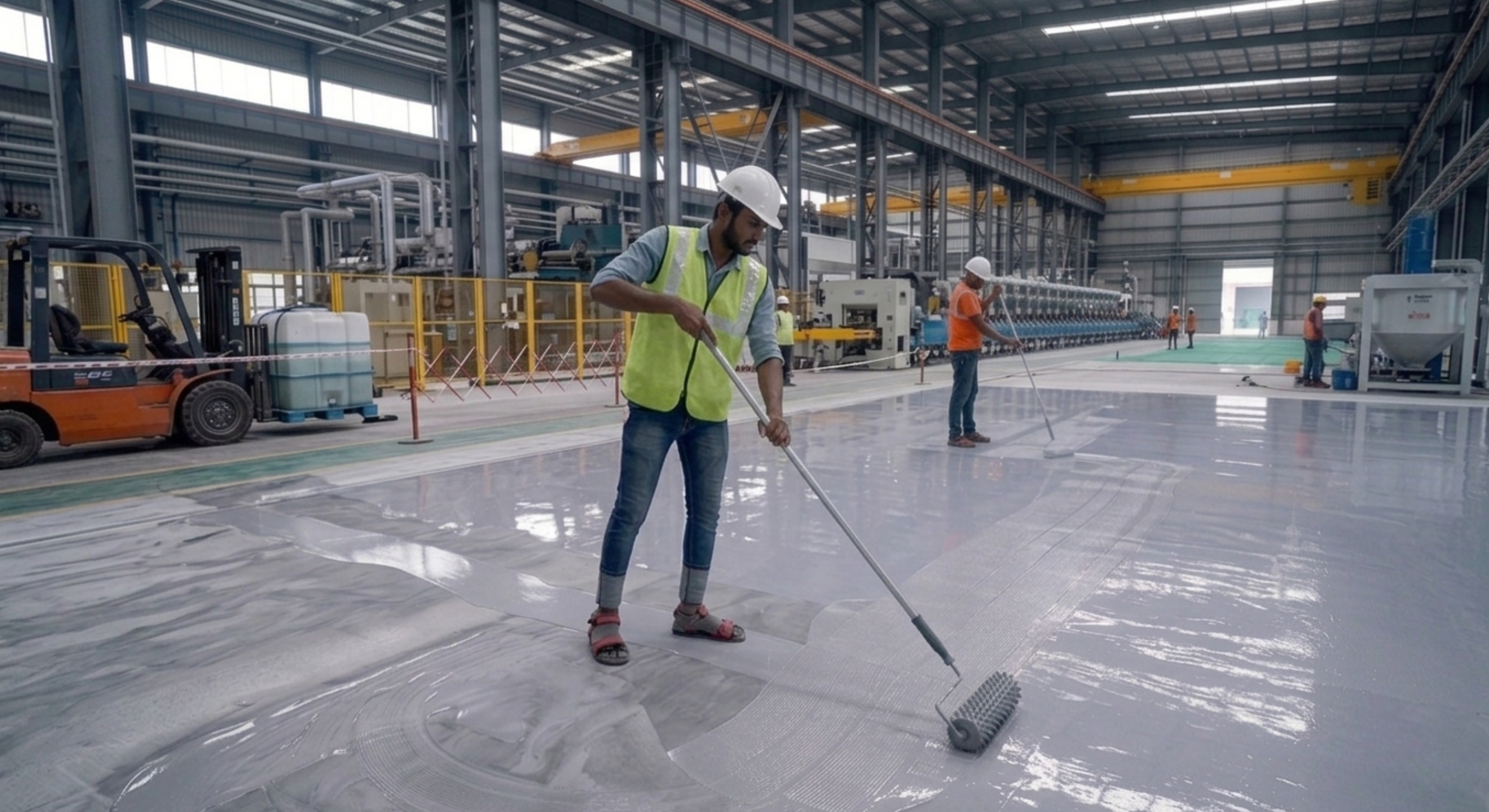
Industrial floors in chemical processing plants live a rough life. They are exposed every day to chemicals, moisture, heavy movement, and temperature swings that push concrete and coatings to their limits. When the flooring system is not matched properly to these conditions, failure shows up early in the form of cracking, peeling, contamination, and constant repair work.
For contractors and plant engineers, knowing how epoxy flooring and PU concrete flooring respond under chemical exposure is not optional. It directly affects how long the floor will last and how often it will need intervention.

What Causes Industrial Floors to Fail in Chemical Plants?
Floors in chemical processing plants are less likely to fail because of a single reason. It is usually a mix of stress factors working together over time.
Some of the most common issues include chemical seepage into concrete, constant forklift movement, thermal cycling from hot water cleaning, moisture rising from the substrate, incorrect system selection, and poor surface preparation before application.
Concrete might look solid, but it is porous. Once chemicals find their way inside, the damage does not stay on the surface. It spreads internally and slowly weakens the structure. That is when you start seeing erosion, loss of adhesion, and surface breakdown.
This is the situation epoxy flooring and PU concrete flooring systems are designed to prevent, provided they are chosen correctly.
Why Chemical Exposure Is the Primary Stress Factor
Chemical exposure is usually the starting point of most flooring failures in these environments. Acids, alkalis, solvents, oils, and industrial cleaners all react differently with unprotected concrete.
The result is fairly predictable. You get surface softening, staining that does not go away, cracking that spreads over time, reduced structural strength, and in many cases, trapped contamination in the slab itself.
Once chemicals get absorbed, cleaning alone cannot reverse the damage. It becomes a structural issue rather than a surface problem. This is where protective systems like industrial epoxy flooring and PU concrete flooring make a real difference.
Epoxy Flooring in Chemical Processing Environments
Epoxy flooring is one of the most commonly used systems in chemical plants. The reason is simple. It bonds well, forms a dense surface, and resists a wide range of industrial chemicals.
When installed properly, industrial epoxy flooring creates a seamless barrier that stops chemicals from reaching the concrete underneath.
Epoxy flooring handles oils, fuels, and solvents effectively. It also carries heavy loads without deforming, which makes it suitable for forklift movement and mechanical operations.
It is commonly used in warehouses, storage zones, utility rooms, and general production areas where chemical exposure is present but relatively controlled.
The limitation shows up in environments where heat and aggressive cleaning are frequent. Under those conditions, epoxy flooring can start to lose performance over time.
PU Concrete Flooring for High Chemical and Thermal Resistance
PU concrete flooring is built for tougher conditions. It is designed for places where chemicals and temperature changes happen together, often in the same cycle.
Unlike rigid systems, PU concrete flooring can handle expansion and contraction without losing integrity. That makes a big difference in real plant conditions.
It performs well against organic and inorganic acids, handles hot water washdowns without damage, and stays stable under steam cleaning and temperature swings. It also resists impact and heavy industrial traffic without breaking down.
You will typically find PU concrete flooring in chemical processing zones, mixing areas, reactors, and wet production spaces where cleaning is aggressive and frequent.
Compared to epoxy flooring, PU concrete flooring holds better when thermal stress is part of the equation.
Key Differences Contractors Need to Know
| Factor | Epoxy Flooring | PU Concrete Flooring |
| Chemical resistance | Strong against oils, fuels, solvents | Strong against acids and aggressive chemicals |
| Thermal resistance | Limited under hot washdowns | High resistance to thermal shock |
| Flexibility | Rigid surface behavior | Handles movement better |
| Cleaning conditions | Works in dry or mild washdown areas | Suitable for steam and hot water cleaning |
| Ideal zones | Warehouses, mechanical areas, dry production floors | Chemical processing, wet zones, hygiene critical areas |
| Mechanical strength | High load capacity | High impact resistance with thermal stability |
Both systems do their job well in different environments. The mistake happens when they are used interchangeably without considering site conditions.
How to Choose the Right Flooring System
There are a few practical questions that usually make the decision clearer.
Start with the chemicals. If the exposure is mostly oils, fuels, or solvents, epoxy flooring is generally suitable. If acids and strong cleaning agents dominate, PU concrete flooring is the safer choice.
Then look at the temperature. Hot washdowns, steam, and rapid temperature changes point towards PU concrete flooring rather than epoxy flooring.
Traffic also matters. Both systems handle forklifts and machinery, but epoxy flooring tends to perform better in dry, high traffic zones.
Finally, consider moisture. Wet and hygiene heavy areas usually need PU concrete flooring because it handles both moisture and thermal stress better.
In many plants, you will see both systems used side by side. Epoxy flooring in dry operational zones and PU concrete flooring in wet or aggressive process areas.
Partner with Sunanda Global
Sunanda Global brings more than 45 years of experience in construction chemicals in India, covering flooring systems, coatings, waterproofing, and concrete protection solutions.
The flooring systems are designed with real industrial conditions in mind, including chemical exposure, humidity, temperature variation, and continuous mechanical load.
With strong R&D focus and ISO 9001:2015 certified processes, Sunanda Global develops epoxy flooring and PU concrete flooring systems built for long term performance in demanding environments.
For technical support, system selection, or substrate evaluation, the Sunanda Global team can assist at the specification stage itself.
Frequently Asked Questions
Q.1. What is the difference between epoxy flooring and PU flooring?
Most failures come down to incorrect system selection, weak surface preparation, moisture rising from the substrate, or exposure to chemicals beyond the system’s resistance range. Thermal shock can also play a role in breakdown over time.
Q.2. How do I decide between epoxy flooring and PU concrete flooring during plant design?
Decisions are typically based on process conditions such as chemical type, cleaning methods, temperature exposure, and traffic intensity in each zone.
Q.3. Can different flooring systems be specified in different zones of the same facility?
Yes. It is common to use epoxy flooring in dry operational areas and PU concrete flooring in wet or high temperature process zones within the same plant.